Rhetoric

paraprosdokian

It’s another rhetorical device this week. Wait, come back! It’s a good ‘un, I promise, despite the rather alarming spelling. A paraprosdokian is a figure of speech in which the second half of the sentence is so surprising or unexpected, it causes you to reframe or reinterpret the first part. Which is a very long-winded way of saying that it makes you do a double take.

In case you’re still not sure what I’m banging on about, here are some famous examples of paraprosdokian in action:

  • ‘I had a wonderful evening, but this wasn't it.’

  • ‘There are three kinds of people in the world: those who can count, and those who can't.’

  • ‘To steal ideas from one person is plagiarism; to steal from many is research.’

  • ‘I want to die peacefully in my sleep like my grandfather – not screaming in terror like his passengers.’ (My personal favourite – thanks to Bob Monkhouse for this banger.)

Geddit? Paraprosdokian plays a trick on how human brains process language. As we read or listen to a sentence, our minds predict how it’ll end based on the context. A paraprosdokian deliberately feeds your brain a familiar setup, lets you walk down that path, then pulls the rug out from under you with a surprise twist. (Not sure why there’s a rug on a path, but you get what I mean.)

As you’ve probably already guessed from the spelling, ‘paraprosdokian’ (which is pronounced para-proz-DOH-kee-un, in case you’re planning to try to impress someone with it later) comes from Ancient Greek. It’s made up of three bits:

  • para- (παρά), meaning ‘against’, ‘beyond’ or ‘contrary to’

  • pros- (πρός), a prefix meaning ‘toward’ or ‘in addition’

  • dokian (δοκία) which comes from dokein (δοκεῖν), meaning ‘to expect’, ‘to think’ or ‘to seem’.

Put it altogether and you get ‘against expectation’ or ‘contrary to what was expected’.

In a neat little twist, paraprosdokian isn’t really what it seems though. While ancient Greek rhetoricians may well have used the technique, the term isn’t actually old at all. In fact, it first appeared in 1896, although no one seems to be sure which smartarse actually coined it.
rhetoric

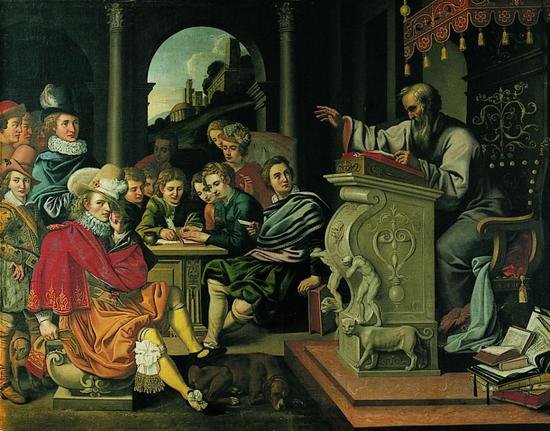
Nowadays, when we say something is ‘rhetoric’, we usually mean it’s a load of bollocks designed to manipulate whoever’s unlucky enough to be listening to it. But this much-maligned word didn’t always have such a negative meaning. In fact, ‘rhetoric’ used to simply refer to the art of persuasion. Throughout Classical Antiquity, the Middle Ages and the Renaissance, ‘rhetoric’ was a prestigious and essential academic discipline, and one of three ancient arts of discourse (also called trivium) along with grammar (yay!) and logic (boo!).

Rhetoric, innit

The word ‘rhetoric’ has a Proto-Indo-European root, *werh₁, which means ‘to speak’ or ‘to say’. This appeared during the Late Neolithic to Early Bronze Age, i.e. bloody ages ago (about 6,500 to 4,500 years ago, if you want actual numbers. Oh, and if you’re wondering about the weird notation, the asterisk means the word was never written down, and the small 1 marks a soft throat sound, apparently). *werh₁ evolved into an Ancient Greek word, eírein, also meaning ‘to speak’, which then produced rhētōr meaning a public speaker or orator (although I’m not sure how – it’s something to do with the Greek letter for W vanishing, I think, but much too boring to go into here, which is saying something). To further complicate things, the Greeks then took the root of rhētōr and added the adjective ending -ikē (meaning ‘pertaining to’ or ‘the skill of’) which created a new adjective, rhētorikē, meaning ‘oratorical’. This clearly wasn’t complicated enough though, so they stuck tékhnē (‘art’, ‘craft’ or ‘technique’) on the end to make it mean ‘the oratorical craft’ or ‘the art of the public speaker’.

Understandably, as time passed people stopped bothering with the tékhnē bit, and just used rhētorikē on its own to mean ‘the art of speaking’. This made its way into Latin as rhētorica, then into 12th-century Old French as retorique, and finally into Middle English in the early 14th century as rethoryke or rhetorik.

Annnnnnd relax.

Now we all know too much about rhetoric, let’s have a look at the tools and techniques that people use when they’re trying to be good at it, AKA rhetorical devices. There are bloody loads of these, and they all have very long complicated names, so I’ll just give you a few. I can almost certainly guarantee you’ve used at least some of them in everyday speech.

Complicated name Sounds like… Actually is… In action
Epizeuxis Something that hangs at the back of your throat Repeating a word or phrase back-to-back with no other words in between to make a point ‘Location, location, location.’
Anaphora A shop that sells overpriced makeup Repeating a phrase at the start of sentences or clauses for emphasis ‘We shall fight on the beaches, we shall fight on the landing grounds, we shall fight in the fields…’
Tricolon A bowel complaint Grouping things in threes to add rhythm and punch ‘Life, liberty and the pursuit of happiness.’
Hyperbole An American sports event that no one outside America cares about Deliberate, extreme exaggeration used to make a point or emphasise a feeling, and not meant to be taken literally (and pronounced ‘hy-PER-buh-lee’, confusingly) ‘I’m so hungry I could eat a horse.’

What about rhetorical questions, I hear you ask in a not-rhetorical way. Yes, rhetorical questions come directly from the study of rhetoric. They’re called that because they were traditionally used to make a point or persuade an audience, with the answer either immediately given by the speaker, or being so bleedin’ obvious that they didn’t need to. In speechmaking, posing a question forces the listener’s brain to process the thought actively rather than just listening (or drifting off…). Rhetorical questions also subtly steer an audience’s thinking without explicitly telling them what to think. Sneaky, huh?

tmesis

This is a linguistic term (don’t fall asleep) for when you stick a word in the middle of another word or phrase. Like ‘fan-bloody-tastic’ or ‘abso-fucking-lutely’. It doesn’t have to be a swearword, but obviously swearing’s funny (and big and clever, regardless of what your parents might tell you).

George Bernard Shaw was one of the first writers to bring tmesis to the masses in Pygmalion, published in 1912, when Eliza Doolittle says ‘abso-blooming-lutely’. And in English we mainly use tmesis like this, for comic effect. But as a rhetorical device, it’s been around for a really long time. It started out in classic literature (although not with swearwords sadly). Homer (of Iliad/Odyssey fame) was a big fan of whacking some tmesis in an epic poem, as was Ovid who used it in Metamorphoses (an 11,995-line narrative poem in Latin – woop woop). Shakepeare also jumped on the tmesis bandwagon and used it in Romeo and Juliet (‘This is not Romeo, he’s some other where,’) and Richard II (this one’s a bit harder to spot, but he’s splitting ye old version of ‘however’:  ‘how heinous e’er it be’).

The word itself first turned up in the 1550s, and is Greek (although you probably guessed that from the weird-ass spelling). It means, unimaginatively, ‘to cut’.

In Australian English, tmesis is called ‘tumba rumba’, which is obviously a much better name, and one I’ll be shoehorning into every conversation I have from now on. No one knows exactly why it’s called this, but it’s probably down to a poem called Tumba-bloody-rumba (1959) by Aussie writer John O’Grady (about the small town of Tumbarumba in New South Wales). It has loads of tmeses in it, which I’m pleased to say almost all involve swearing. Here’s an extract:

This is a kangaroo I met a few weeks ago when I was in Australia.

This is a kangaroo I met a few weeks ago when I was in Australia.

“And the other bloke says ‘Seen’ im? Owed ’im half a bloody quid.
Forgot to give it back to him, but now I bloody did –
Could’ve used the thing me bloody self. Been off the bloody booze,
Up at Tumba-bloody-rumba shootin’ kanga-bloody-roos.”

You can read the whole thing here.

Read the other words of the week.