
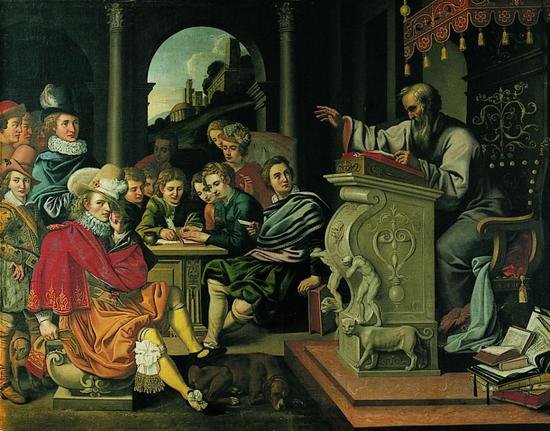
Nowadays, when we say something is ‘rhetoric’, we usually mean it’s a load of bollocks designed to manipulate whoever’s unlucky enough to be listening to it. But this much-maligned word didn’t always have such a negative meaning. In fact, ‘rhetoric’ used to simply refer to the art of persuasion. Throughout Classical Antiquity, the Middle Ages and the Renaissance, ‘rhetoric’ was a prestigious and essential academic discipline, and one of three ancient arts of discourse (also called trivium) along with grammar (yay!) and logic (boo!).
Rhetoric, innit
The word ‘rhetoric’ has a Proto-Indo-European root, *werh₁, which means ‘to speak’ or ‘to say’. This appeared during the Late Neolithic to Early Bronze Age, i.e. bloody ages ago (about 6,500 to 4,500 years ago, if you want actual numbers. Oh, and if you’re wondering about the weird notation, the asterisk means the word was never written down, and the small 1 marks a soft throat sound, apparently). *werh₁ evolved into an Ancient Greek word, eírein, also meaning ‘to speak’, which then produced rhētōr meaning a public speaker or orator (although I’m not sure how – it’s something to do with the Greek letter for W vanishing, I think, but much too boring to go into here, which is saying something). To further complicate things, the Greeks then took the root of rhētōr and added the adjective ending -ikē (meaning ‘pertaining to’ or ‘the skill of’) which created a new adjective, rhētorikē, meaning ‘oratorical’. This clearly wasn’t complicated enough though, so they stuck tékhnē (‘art’, ‘craft’ or ‘technique’) on the end to make it mean ‘the oratorical craft’ or ‘the art of the public speaker’.
Understandably, as time passed people stopped bothering with the tékhnē bit, and just used rhētorikē on its own to mean ‘the art of speaking’. This made its way into Latin as rhētorica, then into 12th-century Old French as retorique, and finally into Middle English in the early 14th century as rethoryke or rhetorik.
Annnnnnd relax.
Now we all know too much about rhetoric, let’s have a look at the tools and techniques that people use when they’re trying to be good at it, AKA rhetorical devices. There are bloody loads of these, and they all have very long complicated names, so I’ll just give you a few. I can almost certainly guarantee you’ve used at least some of them in everyday speech.
| Complicated name | Sounds like… | Actually is… | In action |
|---|---|---|---|
| Epizeuxis | Something that hangs at the back of your throat | Repeating a word or phrase back-to-back with no other words in between to make a point | ‘Location, location, location.’ |
| Anaphora | A shop that sells overpriced makeup | Repeating a phrase at the start of sentences or clauses for emphasis | ‘We shall fight on the beaches, we shall fight on the landing grounds, we shall fight in the fields…’ |
| Tricolon | A bowel complaint | Grouping things in threes to add rhythm and punch | ‘Life, liberty and the pursuit of happiness.’ |
| Hyperbole | An American sports event that no one outside America cares about | Deliberate, extreme exaggeration used to make a point or emphasise a feeling, and not meant to be taken literally (and pronounced ‘hy-PER-buh-lee’, confusingly) | ‘I’m so hungry I could eat a horse.’ |
What about rhetorical questions, I hear you ask in a not-rhetorical way. Yes, rhetorical questions come directly from the study of rhetoric. They’re called that because they were traditionally used to make a point or persuade an audience, with the answer either immediately given by the speaker, or being so bleedin’ obvious that they didn’t need to. In speechmaking, posing a question forces the listener’s brain to process the thought actively rather than just listening (or drifting off…). Rhetorical questions also subtly steer an audience’s thinking without explicitly telling them what to think. Sneaky, huh?