
‘Gauche’ describes someone or something that’s awkward, tactless or lacking social graces. If you did any French at school, you probably remember that ‘gauche’ is French for ‘left’, and that’s exactly where we get this word from. But why does ‘left’ translate to using the wrong fork at dinner or calling without texting first (shudder)?
(Before I get into this, apologies to any members of the left-handed community, which includes my mum, for what I’m about to say.)
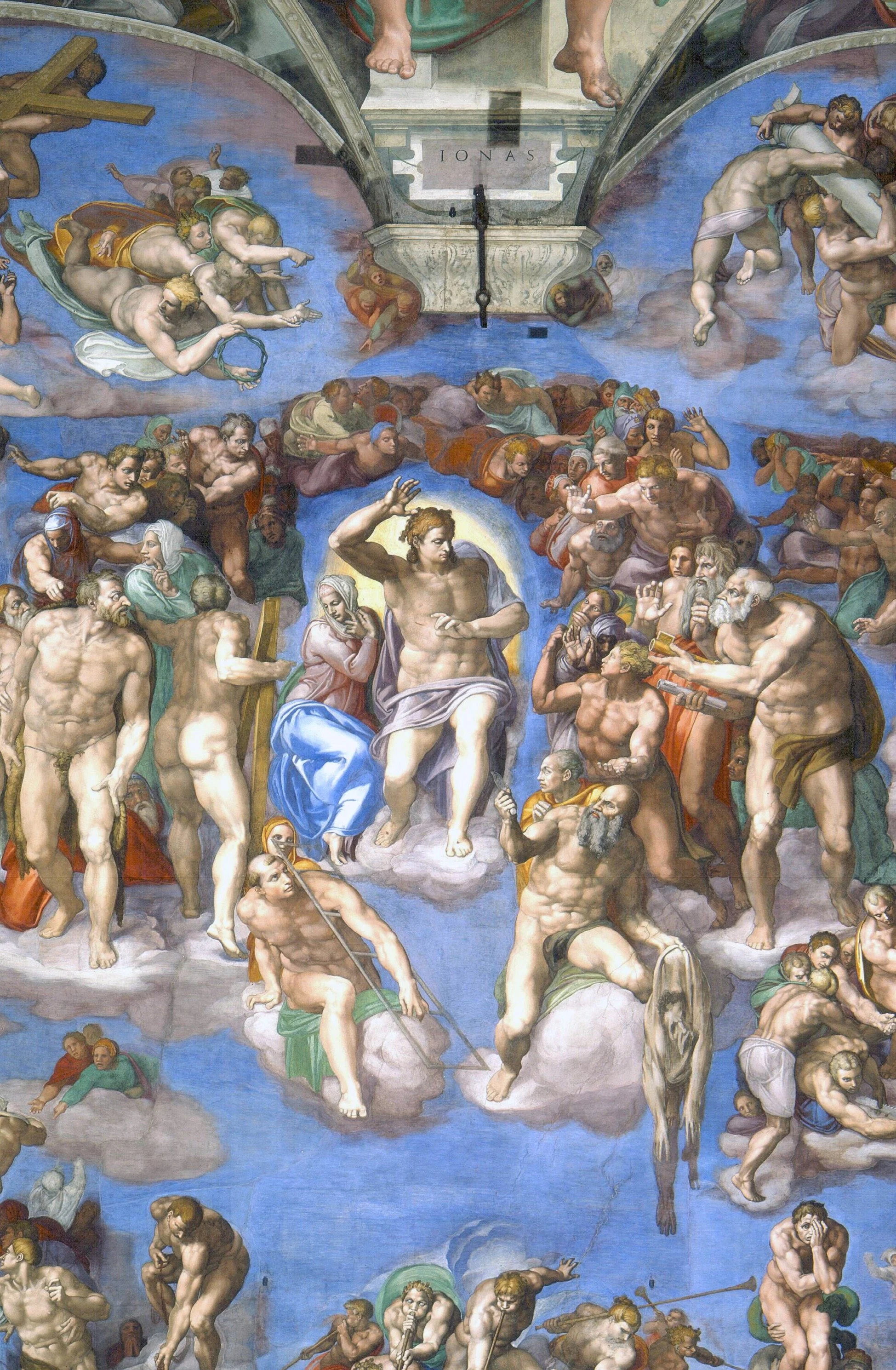
A bit of Michaelangelo’s The Last Judgment showing Christ waving his arms in the air like he just don’t care, sorry, I mean separating the righteous from the damned with his right and left hands.
Historically in Europe, being left-handed was associated with being clumsy or downright evil. This was down to the fact that 90% of people are right-handed, and us humans have always had a tendency to view anything outside the ‘norm’ with suspicion. It’s down to language too (handy for me) – the word ‘sinister’ literally translates to ‘on the left side’ in Latin, while ‘dexter’, meaning ‘right’, implies skill and cleverness, and has given us words like ‘dexterous’.
Many major religious and spiritual traditions heavily favoured righthandedness too. It all kicked off with poor old Eve (of course), who, according to later medieval legend (it actually doesn’t specify in Genesis), was created from Adam’s left side – and we all know how that ended up. According to one online source I found, the Bible has over 100 favourable references to the right-hand alongside 25 unfavourable ones to the left-hand. For example, in Psalm 118, it says ‘The right hand of the Lord is exalted: the right hand of the Lord doeth valiantly’. And the parable of the sheep and the goats in Matthew describes how God will divide nations on Judgment Day ‘as a shepherd divideth his sheep from the goats; and he shall set the sheep [the good guys AKA the righteous] on his right hand, but the goats [the damned] on the left’. Poor old goats.
Lefties don’t fare much better in Islam either – in the Middle East, the left hand is seen as dirty, mainly due to the custom of using it to, well, wipe your bum. (There’s a theory that this is where we get ‘cack-handed’ from, though the origins are thankfully shrouded in mystery.)
So, after centuries of religious bias, linguistic snobbery and literal witch-hunts, ‘left’ had ended up with quite a bit of baggage. And when 18th-century English aristocrats started pinching French vocab to sound cultured (the earliest recorded use of ‘gauche’ in English is in a letter by one Lord Chesterfield in 1751), they adopted ‘gauche’ as a snappy insult for anyone lacking high-society polish – turning a simple direction into a go-to phrase for being a total social disaster.