
military

redoubt

This is one of the (many) words I’ve seen hanging around, but never really knew what it meant. And it’s nothing to do with doubting again or even being redoubtable (another word I had to look up – it means ‘very strong, especially in character; producing respect and a little fear in others’). A redoubt is a fort, usually made up of an enclosed defensive structure outside a larger fort. Redoubts are meant to protect soldiers who are outside the main defensive line, and can be permanent structures or temporary fortifications. ‘Redoubt’ can also refer more broadly to any safe or protected place, both literally and figuratively.

You could be forgiven for thinking that ‘redoubt’ is a member of the same etymological family as ‘doubt’ or the aforementioned ‘redoubtable’. Both of these come from a Latin verb, dubitare, which means, rather boringly, ‘to be in doubt’. But the English language doesn’t like to play fair, so of course ‘redoubt’ actually comes from a completely different Latin verb, reducere. That means ‘to lead back’, and is also where we get the word ‘reduce’ from.

‘Redoubt’ found its way into English via the Italian word ridotto and the French word redoute. Nobody’s quite sure where the extra, some might say redundant, ‘b’ came from. Some etymologists have guessed, sorry, theorised that it might have been mixed up with another ‘redoubt’ which has since fallen by the wayside. This now-vanished verb does come from dubitare, and meant ‘to regard with awe, dismay or dread’.

In the UK, we have a few redoubts, many of which date back to the Napoleonic Wars. Harwich Redoubt in Essex, Eastbourne Redoubt in East Sussex and Dymchurch Redoubt in Kent are the most famous (or at least they were the first ones that came up on my search engine). As a proud Essex girl, I’m pleased to say that we win the battle of the redoubts – Harwich Redoubt is a massive, 180-foot-diameter circular fort built in 1808, and one of the best-preserved redoubts in Britain. It has a central parade ground, 11 gun emplacements along the battlements and a moat. If you're harbouring any lingering doubts about Essex’s superiority, you can go and visit it – it’s now a museum run by the Harwich Society.

Eastbourne Redoubt was finished in 1810 to cover the beaches of Pevensey Bay. It hasn’t fared as well as its Essex cousin – it used to be a museum, but it’s currently closed to the public due to concerns bits of it might fall off and kill some unsuspecting redoubt enthusiast (AKA ‘structural safety concerns’).

The final member of our trio, Dymchurch Redoubt, was built between 1804 and 1812 to support a chain of 21 Martello towers (small coastal defence forts) that stretched between Hythe in Kent and Rye in Sussex. But, like many of the military’s best-laid plans, by the time it was finished, the invasion threat was over.

Unlike Harwich and Eastbourne, Dymchurch Redoubt is still owned by the Ministry of Defence and is used for military training. It also appears to be falling down, with English Heritage listing it as ‘at risk’. You might be at risk if you decide to go and have a wander round Dymchurch Redoubt too – the area around it is used as a firing range by the military. So if the crumbling masonry doesn't get you, the live ammunition might.
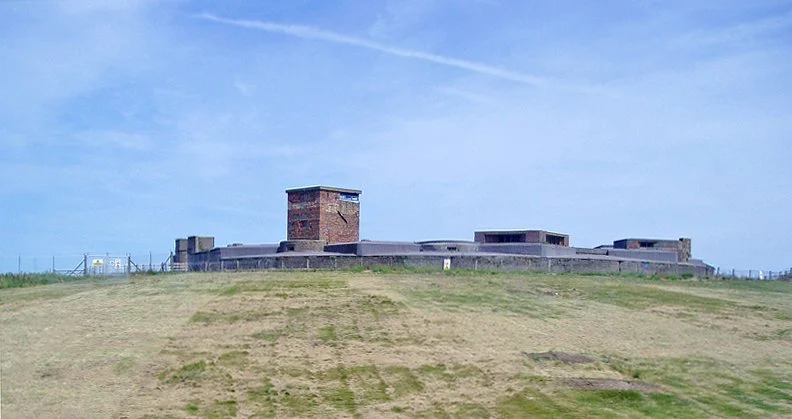
Dymchurch: undoubtably a redoubtable redoubt (photo: Ian Dunster at English Wikipedia)

havoc

If you’ve ever come home to find your usually well-behaved (well, kinda) cavapoo has decided to redecorate the lounge using the stuffing from three cushions and the contents of the kitchen bin, you’ve seen havoc in action.

As a noun, ‘havoc’ describes widespread destruction, confusion or disorder. It’s the kind of chaos that doesn’t just happen; it’s wreaked. And it turns out that its origins are rooted in a specific – and actually quite terrifying – military command.

In the Middle Ages, ‘Havoc!’ was a formal cry used during a conflict. It signalled that soldiers could start plundering and looting, grabbing whatever the olde equivalent of flat-screen TVs and games consoles was, and generally causing as much mayhem as they liked. The command came from an Old French word, havot, meaning pillaging. During the 14th century, as French-speaking officers gave orders to English-speaking troops, the soft French ‘t’ was gradually hardened into the English ‘k’. This is probably due to something called folk etymology, which is when a foreign word enters a language and people subconsciously ‘correct’ it to something that already sounds familiar to them. In this case, that was hafoc, the Old English name for a predatory hawk – to a 14th-century soldier, the command to start looting and pillaging might have felt conceptually very similar to the action of a hawk swooping down to snatch its prey.

Havoc time (did you just read that as MC Hammer? Maybe that’s just me) was so destructive that it had to be legally regulated. In 1385, Richard II issued the ‘Statutes of War’, which specifically forbade shouting ‘Havoc’ without authorisation under penalty of death. So anyone who lost their head and got overly enthusiastic about being first to the lootfest would quite literally lose it for real shortly after.

The most famous literary appearance of ‘havoc’ comes courtesy of, you’ve guessed it, William Shakespeare. In Julius Caesar, Mark Antony promises to ‘Cry “Havoc!” and let slip the dogs of war’. Today, we use ‘havoc’ for much lower stakes, though I’m fairly certain my dog still hears the 14th-century call to arms the second the front door clicks shut behind me.

muster

These days, most mustering is about courage or passing: ‘I mustered the courage to speak up’ or ‘that comment doesn’t pass muster.’ But originally it referred to a formal gathering of troops for inspection. Medieval armies would call all their soldiers together to check no one was AWOL, and that they were all properly armed and fit for duty – and that was called ‘a muster’.

14th-century ‘muster rolls’ show sheriffs and commanders doing just that: assembling the county’s able-bodied men, checking weapons and recording who turned up (muster rolls are not to be confused with roll calls, which are when someone reads aloud the names of the people on the muster roll to check who’s there).

‘Muster’ has other military uses too – when a military unit is created, it’s ‘mustered in’, and when it’s disbanded, it’s ‘mustered out’.

This is of course where we get the phrase ‘passing muster’ from, which has been around since the late 16th century, although then it was ‘pass the muster’. It wasn’t long until we dropped the ‘the’, and started using ‘muster’ in a more figurative, non-military way to mean ‘to gain acceptance or approval’.

‘Muster’ comes from a Latin word, ‘monstrare’, which means ‘to show’. This passed into Old French as ‘mostrer’ and then into Middle English as ‘muster’.

During Jubilee years, British armed forces perform a muster for the king or queen. This tradition dates back to Tudor times, and gives the military a chance to show the monarch what they do and what they look like. The 2012 Diamond Jubilee Armed Forces Parade and Muster was the first time all three service branches were present at the same time to celebrate Elizabeth II’s years on the throne. 2,500 servicemen and women took part in it, and it was the first major event of the Diamond Jubilee.