
This is one of the (many) words I’ve seen hanging around, but never really knew what it meant. And it’s nothing to do with doubting again or even being redoubtable (another word I had to look up – it means ‘very strong, especially in character; producing respect and a little fear in others’). A redoubt is a fort, usually made up of an enclosed defensive structure outside a larger fort. Redoubts are meant to protect soldiers who are outside the main defensive line, and can be permanent structures or temporary fortifications. ‘Redoubt’ can also refer more broadly to any safe or protected place, both literally and figuratively.
You could be forgiven for thinking that ‘redoubt’ is a member of the same etymological family as ‘doubt’ or the aforementioned ‘redoubtable’. Both of these come from a Latin verb, dubitare, which means, rather boringly, ‘to be in doubt’. But the English language doesn’t like to play fair, so of course ‘redoubt’ actually comes from a completely different Latin verb, reducere. That means ‘to lead back’, and is also where we get the word ‘reduce’ from.
‘Redoubt’ found its way into English via the Italian word ridotto and the French word redoute. Nobody’s quite sure where the extra, some might say redundant, ‘b’ came from. Some etymologists have guessed, sorry, theorised that it might have been mixed up with another ‘redoubt’ which has since fallen by the wayside. This now-vanished verb does come from dubitare, and meant ‘to regard with awe, dismay or dread’.
In the UK, we have a few redoubts, many of which date back to the Napoleonic Wars. Harwich Redoubt in Essex, Eastbourne Redoubt in East Sussex and Dymchurch Redoubt in Kent are the most famous (or at least they were the first ones that came up on my search engine). As a proud Essex girl, I’m pleased to say that we win the battle of the redoubts – Harwich Redoubt is a massive, 180-foot-diameter circular fort built in 1808, and one of the best-preserved redoubts in Britain. It has a central parade ground, 11 gun emplacements along the battlements and a moat. If you're harbouring any lingering doubts about Essex’s superiority, you can go and visit it – it’s now a museum run by the Harwich Society.
Eastbourne Redoubt was finished in 1810 to cover the beaches of Pevensey Bay. It hasn’t fared as well as its Essex cousin – it used to be a museum, but it’s currently closed to the public due to concerns bits of it might fall off and kill some unsuspecting redoubt enthusiast (AKA ‘structural safety concerns’).
The final member of our trio, Dymchurch Redoubt, was built between 1804 and 1812 to support a chain of 21 Martello towers (small coastal defence forts) that stretched between Hythe in Kent and Rye in Sussex. But, like many of the military’s best-laid plans, by the time it was finished, the invasion threat was over.
Unlike Harwich and Eastbourne, Dymchurch Redoubt is still owned by the Ministry of Defence and is used for military training. It also appears to be falling down, with English Heritage listing it as ‘at risk’. You might be at risk if you decide to go and have a wander round Dymchurch Redoubt too – the area around it is used as a firing range by the military. So if the crumbling masonry doesn't get you, the live ammunition might.
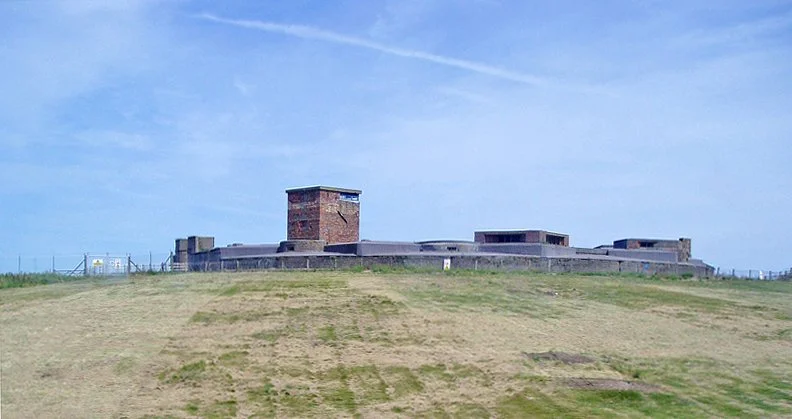
Dymchurch: undoubtably a redoubtable redoubt (photo: Ian Dunster at English Wikipedia)