
Gastronomic words

treacle

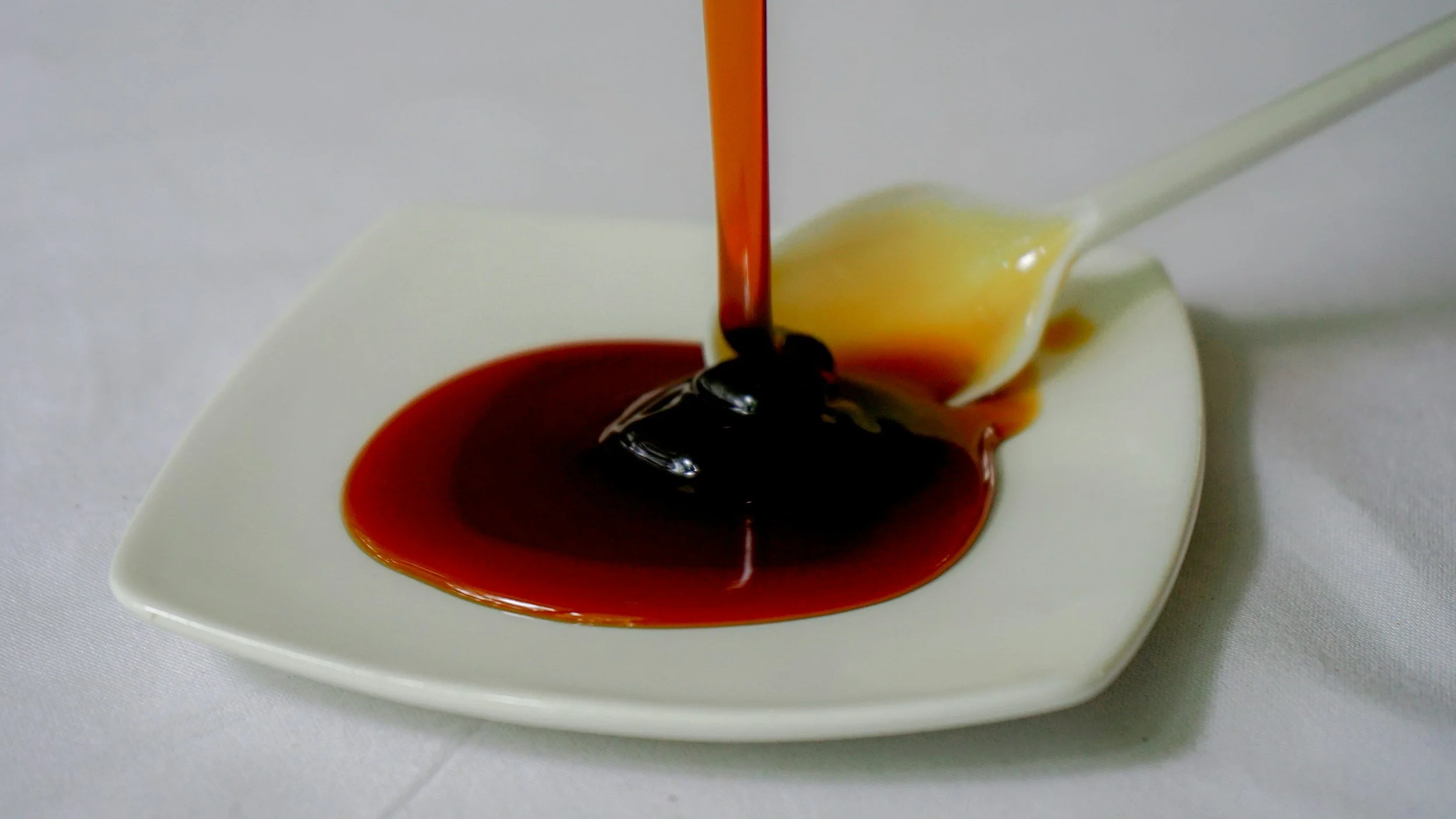
I’m pretty sure you know what treacle is – uncrystallised syrup made during the refining of sugar. Okay, maybe you didn’t know that. But I’m sure you do know that it’s the sticky stuff that we use in many a pudding (my mum makes a killer treacle sponge pudding). Why ‘treacle’ though? Well, it turns out the word itself has distinctly medicinal origins.

As so many of these stories do, this one begins in ancient Greece. The word we’re interested in this time is thēriakos, meaning ‘of a wild animal’. Since lots of wild animals enjoy taking a chunk out of us human beings, thēriakē came to mean ‘antidote against a poisonous bite’. Latin borrowed this as theriaca, and the word eventually made its way through Old French into Middle English as triacle with this meaning. The earliest recorded use of it in English dates to 1340, in a text called ‘Ayenbite of Inwyt’ where it refers to an antidote to poisons and snakebites.
(Just a quick aside: the ‘Ayenbite of Inwyt’ – literally the ‘again-biting of inner wit’ or the ‘Remorse of Conscience’ – is the title of a confessional prose work written in a Kentish dialect of Middle English. Wikipedia describes it as: ‘Rendered from the French original, one supposes by a “very incompetent translator,” it is generally considered more valuable as a record of Kentish pronunciation in the mid-14th century than exalted as a work of literature’. BURN.)

So how did we get from ‘remedy for painful bite’ to ‘sticky stuff on puds’? Well, theriac recipes often contained honey in large quantities – sometimes three times the weight of all the dry ingredients combined. Because of this, the meaning of ‘treacle’ later became associated with the sticky dark syrup left over from the process of sugar refining. This was probably because of a perceived resemblance to the old medicinal preparations. Or maybe just because it was really sweet.

‘Treacle’ is primarily a British term for what Americans call molasses, even though the two products aren’t actually identical – molasses is typically boiled for longer, creating a thicker, darker liquid with less sugar (and less fun, by the sounds of it). The figurative sense, meaning cloyingly sentimental, does appear in some American writing, but it’s less common than it is in British. Oh, and the pet name (‘Hello Treacle’), beloved of Pete Beale in Eastenders (showing my age there), comes from Cockney rhyming slang, where ‘treacle tart’ means ‘sweetheart’.

bletting

Some fruits, particularly sloes and medlars (more on those later), can be a bit sour to eat, even when they’re ripe (due to high levels of tannins). And that’s where our word of the week comes in – to make them more edible, we blet them. This basically means letting them go past fully ripe to the point where they’re just starting to break down, but aren’t quite rotting yet. Yum.

There seems to be quite an art to bletting – let it go too long and obviously the fruit’s too minging to eat. Don’t do it enough and it’ll be too bitter to enjoy. Having said that, it’s a fairly hands-off process, and mainly involves storing fruit at room temperature then looking at it every now and again. There seems to be some poking involved as well.

Etymology-wise, we can trace ‘blet’ back to the Old English word ‘blætt’ or ‘blǣtt’, that was used to describe anything a bit squishy or soft.

Four medlars, in all their bummy glory (photo © Andrew Dunn, 1 October 2005).

One fruit that’s inedible before bletting is the medlar, which you possibly haven’t heard of. Medlars were actually very popular here in Blighty a few hundred years ago. They go back even further than that as well – the medlar tree comes from Persia, and ye olde Greeks and Romans grew them too. They possibly fell out of favour because a perfectly bletted medlar is brown and squishy to the point that you might think it’s going to collapse in your hand. Doesn’t sound terribly appetising, does it?

Medlars also aren’t the most attractive of fruits – in fact, in France they’re called ‘cul de chien’ which translates as ‘dog’s arse’. Shakespeare called them ‘open-arse’ in Romeo and Juliet (which paints a lovely picture), and DH Lawrence referred to them as ‘autumnal excrementa’ (‘autumn shit’) in his poem ‘Medlars and Sorb-Apples’. That ode starts with these delightful lines:

‘I love you, rotten,

Delicious rottenness.’

Despite all this bad press, the much-maligned medlar is making a bit of a comeback. Medlar jelly is apparently lovely with a bit of cheese, and you can buy it online. Go on, treat yourself to some autumnal poop. You know you want to.

ketchup

Think ketchup originated in America? Well, despite the fact that 97% of American households have a bottle of the red stuff in their kitchens, this condiment actually started life on much more exotic shores. The word ketchup comes from a Hokkien Chinese word, ‘kê-tsiap’, which was the name of a sauce made from fermented fish. (While any food with the word ‘fermented’ in it just doesn’t sound appetising, I think this was actually quite similar to soy sauce.)

So how did ketchup migrate? Well, it’s likely that British travellers brought ‘kê-tsiap’ home, before attempting to recreate it in their kitchens and anglicising it as ‘catchup’ (also ‘catsup’). The first written mention of ‘catchup’ is in ‘A New Dictionary of the Terms Ancient and Modern of the Canting Crew’, a dictionary of English slang first published in 1698. It has over 4,000 entries and, frankly, sounds awesome.

At some point ‘catchup’ mutated into ‘ketchup’. And the first published recipe for ketchup appeared in 1727, in ‘The Compleat Housewife’, an incredibly popular cookbook by Eliza Smith which went through a massive 18 editions. Ingredients in Smith’s recipe included anchovies, shallots, vinegar, ginger and nutmeg, and involved shaking the bottle once or twice a day for a week before using it. A second recipe for ‘ketchup in paste’ appeared in 1732, written by one Richard Bradley (who was the first professor of botany at Cambridge University, and also published the first recipe with pineapple in it – hopefully it wasn’t a pizza). This still wasn’t the ketchup we know today though – the main ingredient was red beans, and there definitely weren’t any tomatoes in there. Other versions followed, often containing mushrooms (apparently Jane Austen was a big fan of mushroom ketchup), unripe walnuts (YUM) and oysters. At this point ‘ketchup’ was really just another word for ‘sauce’.

Despite having been brought to England in the 1500s from South America, tomatoes weren’t popular as people actually thought they were poisonous (possibly due to the lead from lead pewter plates leaching into them). So it wasn’t until around 1812 that the first tomato ketchup recipe appeared. James Mease, a scientist from Philadelphia, gets the credit for this, although he loses points for calling tomatoes ‘love apples’ (due to their reputation for being an aphrodisiac – which seems somewhat at odds with the whole poison thing, but never mind), which doesn’t seem very scientific, and sounds gross. A little start-up by the name of Heinz then introduced their recipe in 1876, and the red sauce we know today was born. Today Heinz is the best-selling brand of ketchup in the United States, with more than 650 million bottles sold every year.

I still don’t like it though.