
I’m sure you know what a gargoyle is – an ugly little devil-like figure, often winged, that sits high up on the outside walls of churches, cathedrals and other Christian buildings to ward off evil. Well, you’re half right. A gargoyle is one of those things, but only if it has a hole where its mouth is for water to flow out of. That’s because gargoyles actually have a very practical purpose – to channel rainwater through their mouths and away from church walls, so the stonework didn’t crumble. If it doesn’t have any water flowing through it, it’s a grotesque. So all gargoyles are grotesques, but not all grotesques are gargoyles.

‘Gargoyle’ goes back to an Old French word, ‘gargouille’, which means ‘throat’ or ‘gullet’. That comes via Medieval Latin from ‘gargola’/‘gargulio’. It’s the same root as ‘gargle’ – both words echo the sound of liquid gurgling down the throat.
So far, so good. But who decided to gussy up gutters as gargoyles in the first place? Well, we have a French legend to thank for that. The story goes that in 7th-century Rouen, a dragon-like creature called La Gargouille was terrorising the town, breathing fire and flooding it with water (I’m not entirely sure how the fires turned into floods, but let’s gloss over that). When the townspeople finally defeated it, they mounted its head and neck on the town’s church. And that’s apparently the reason why gargoyles came to be carved onto churches as both water spouts and protectors.
(In truth, it was probably just the whimsy of medieval architects and designers – but that doesn’t make for nearly as good a story.)
Gargoyles and grotesques might feel like an olde worlde thing, but they’re still being added to buildings today. Paisley Abbey in Scotland was built in the 12th century and restored in the 1990s. A stonemason hired to replace 12 crumbling stone gargoyles added a grotesque that looks exactly like the xenomorph from the 1979 film ‘Alien’ – great to see a modern movie monster keeping company with its medieval cousins.
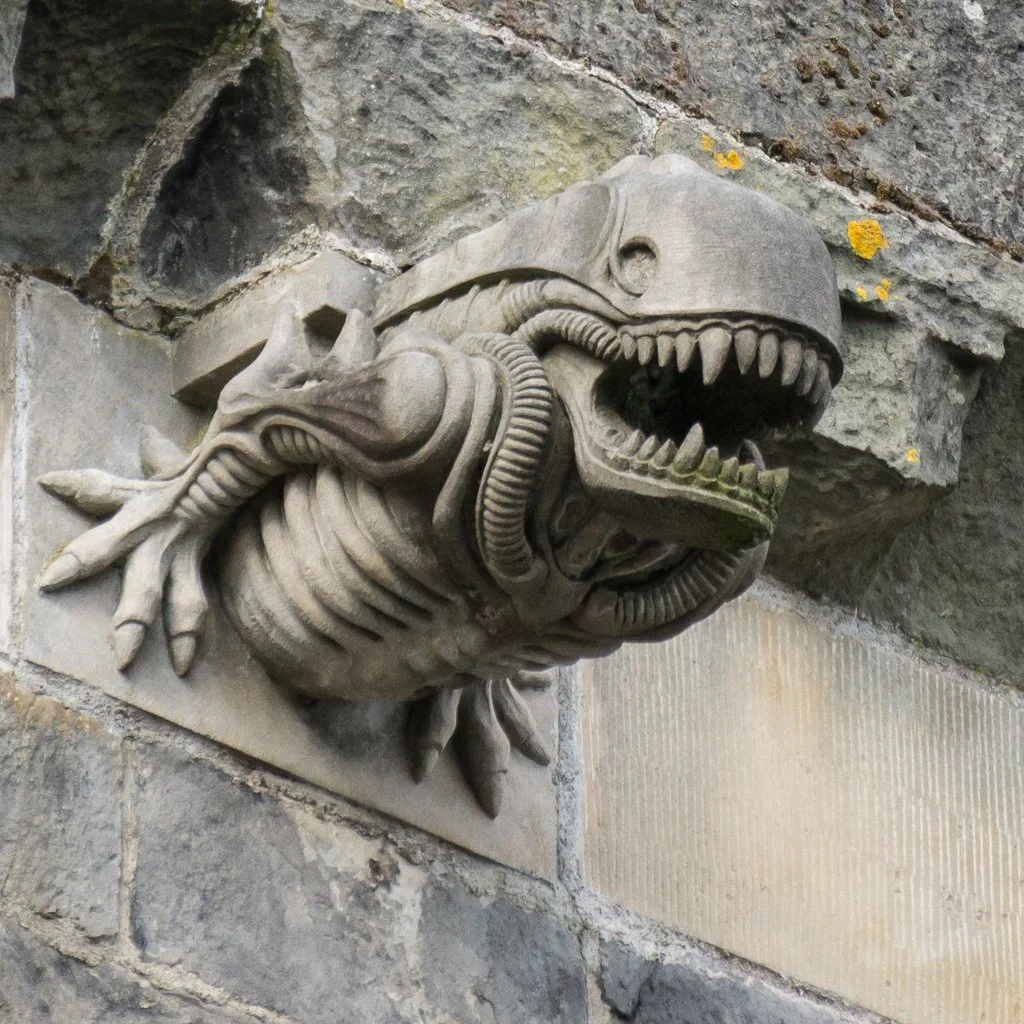
Image credit: Colin, via Wikimedia Commons, CC BY-SA 3.0
