
Bible

gauche

‘Gauche’ describes someone or something that’s awkward, tactless or lacking social graces. If you did any French at school, you probably remember that ‘gauche’ is French for ‘left’, and that’s exactly where we get this word from. But why does ‘left’ translate to using the wrong fork at dinner or calling without texting first (shudder)?

(Before I get into this, apologies to any members of the left-handed community, which includes my mum, for what I’m about to say.)
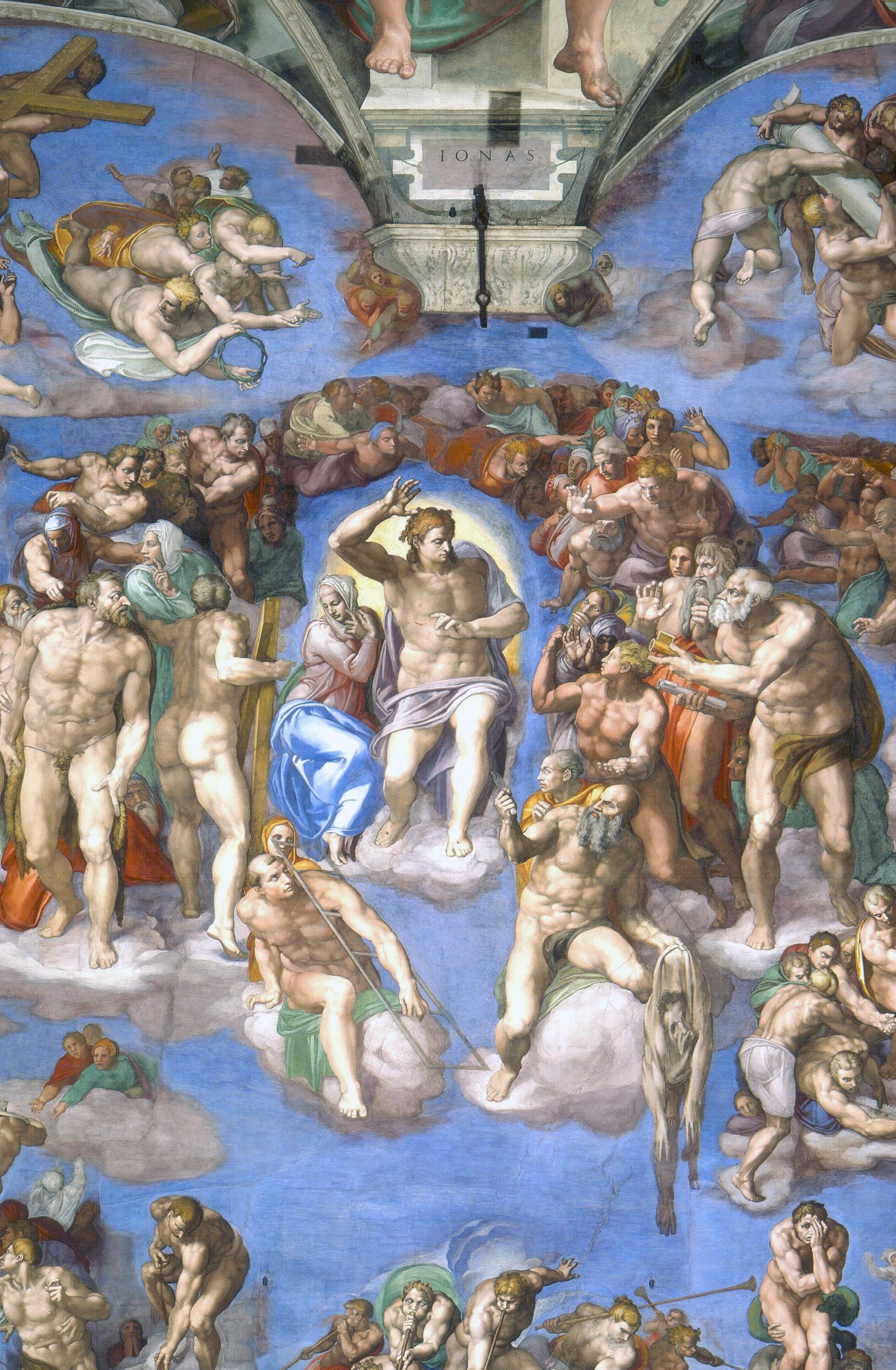
A bit of Michaelangelo’s The Last Judgment showing Christ waving his arms in the air like he just don’t care, sorry, I mean separating the righteous from the damned with his right and left hands.

Historically in Europe, being left-handed was associated with being clumsy or downright evil. This was down to the fact that 90% of people are right-handed, and us humans have always had a tendency to view anything outside the ‘norm’ with suspicion. It’s down to language too (handy for me) – the word ‘sinister’ literally translates to ‘on the left side’ in Latin, while ‘dexter’, meaning ‘right’, implies skill and cleverness, and has given us words like ‘dexterous’.

Many major religious and spiritual traditions heavily favoured righthandedness too. It all kicked off with poor old Eve (of course), who, according to later medieval legend (it actually doesn’t specify in Genesis), was created from Adam’s left side – and we all know how that ended up. According to one online source I found, the Bible has over 100 favourable references to the right-hand alongside 25 unfavourable ones to the left-hand. For example, in Psalm 118, it says ‘The right hand of the Lord is exalted: the right hand of the Lord doeth valiantly’. And the parable of the sheep and the goats in Matthew describes how God will divide nations on Judgment Day ‘as a shepherd divideth his sheep from the goats; and he shall set the sheep [the good guys AKA the righteous] on his right hand, but the goats [the damned] on the left’. Poor old goats.

Lefties don’t fare much better in Islam either – in the Middle East, the left hand is seen as dirty, mainly due to the custom of using it to, well, wipe your bum. (There’s a theory that this is where we get ‘cack-handed’ from, though the origins are thankfully shrouded in mystery.)

So, after centuries of religious bias, linguistic snobbery and literal witch-hunts, ‘left’ had ended up with quite a bit of baggage. And when 18th-century English aristocrats started pinching French vocab to sound cultured (the earliest recorded use of ‘gauche’ in English is in a letter by one Lord Chesterfield in 1751), they adopted ‘gauche’ as a snappy insult for anyone lacking high-society polish – turning a simple direction into a go-to phrase for being a total social disaster.

nimrod

You probably know nimrod as a slightly old-fashioned way of calling someone an idiot. A dope or a dimwit. But like lots of our words, it didn’t start out like that.

‘Put your hands in the air like you just don’t care’ (Nimrod by David Scott, 1832)

The OG Nimrod was a biblical figure. In the Book of Genesis, he’s described as ‘a mighty hunter before the Lord’. He was one of Noah’s great-grandsons, a warrior, a king, a symbol of power and skill, and an all-round over-achiever. Oh, except for the fact that he commissioned the Tower of Babel which, if you know your bible, didn’t end well. Despite that, for centuries, the word ‘nimrod’ was used to mean a hunter or someone with great prowess.

Then Looney Tunes got involved. Yup.

In a 1948 cartoon, What Makes Daffy Duck, Daffy calls Elmer Fudd a ‘nimrod’. Not because Elmer was a great hunter – quite the opposite. He was famously incompetent, and Daffy was being hella sarcastic. Bugs Bunny also used the word later, calling Yosemite Sam ‘the little Nimrod’ in Rabbit Every Monday (1951).

But here’s where it gets interesting: the audience didn’t always get the reference. In fact, most people didn’t know the biblical meaning. So while they understood that Daffy and Bugs were mocking Elmer/Yosemite, they took ‘nimrod’ to mean idiot, not hunter. And because Looney Tunes was such a massive part of pop culture at the time, that misinterpretation stuck.

This is a great example of how language evolves in unexpected ways – not because of formal definitions or careful usage, but because a cartoon duck and rabbit made high-brow jokes that nobody got.

marionette

It’s World Puppetry Day today, which is organised by the Union Internationale de la Marionnette (UNIMA). So that’s why I’ve chosen ‘marionette’ as this week’s WOTW (as no one calls it).

A marionette is a puppet controlled from above using wires or strings (so other types of puppets like ventriloquists’ dummies or Sooty aren’t marionettes – except in France, where it refers to any type of puppet). As you can probably guess from the spelling, the word ‘marionette’ comes from French. For some reason we lost an ‘n’ when it came into English, as the OG French term was ‘marionnette’. That comes from an Old French word, ‘marion’, which means ‘little Mary’. This is likely because the earliest marionettes were used to depict biblical events, in which the Virgin Mary was a big star.

How much is that scary puppet in the window?

Puppetry has been around for bloody ages, and some historians claim they actually predate actors in the theatre. In fact, there’s evidence of string operated puppets as far back as 2000 BC in Egypt. But who cares about that when we can talk about HAUNTED PUPPETS?

In 2015 paranormal investigator Jayne Harris filmed a supposedly haunted puppet every night for three months using a timed night vision camera. She was called in after its previous owner, who inherited it from his late father, claimed it tried to CHOKE HIM TO DEATH in the middle of the night. You can read more and see the (slightly underwhelming) video footage in this article.

If that doesn’t convince you, what about Mr Fritz, a disembodied ventriloquist doll’s head, which was caught on camera BLINKING in the middle of the night. Mr Fritz was made by a prisoner at the World War II Stalag II-B concentration camp. His new owner noticed that the door to the case the head was stored in kept opening over night, so he set up a camera to see what was going on. You can see the footage of the blinks in this article (my apologies that it’s from the Daily Mail). HIS LIPS BLOODY MOVE TOO.

Sleep well tonight…

charisma

Charisma Carpenter – yes, that is her real name – of Buffy the Vampire Slayer fame (photo credit: Gage Skidmore – also an excellent name)

The excellently named Charisma Carpenter – yes, that is her real name – of Buffy the Vampire Slayer fame (photo credit: Gage Skidmore – also an excellent name)

Someone who’s charismatic is charming, attractive and often a little bit sexy. But you know that already. But did you know that ‘charisma’ actually has its roots in religion, specifically Christianity? It was only in the early 20th century that it came to have the little-bit-sexy meaning it has today.

‘Charisma’ originally comes from the Greek word ‘kharisma’ (so not much of a leap there) which means ‘favour freely given’ or ‘gift of grace’. Both the Hebrew and Christian Bibles talk about divinely conferred charisma, which is used to talk about someone who’s a favourite of him/her upstairs i.e. who’s received God’s favour. In English, from about 1640 onwards, people used ‘charisma’ to refer to a gift or power bestowed on someone by the Holy Spirit for the good of the church.

So where did the sexy come in? I’m afraid that’s a very unsexy story. German sociologist Max Weber came up with a new definition of charisma some time before 1920 (it was found in an unfinished manuscript after he died), which is generally regarded as having dragged the concept from theological obscurity into everyday use. He described it as:

“… a certain quality of an individual personality by virtue of which he is set apart from ordinary men and treated as endowed with supernatural, superhuman, or at least specifically exceptional powers or qualities. These as such are not accessible to the ordinary person …”