

Like lots of British people, you might think Hallowe’en (and yes, I am going to use the apostrophe all the way through this article) is an American import, along with trick-or-treating, jack-o’-lanterns (another pleasing apostrophe) and so on. But you would be dead (see what I did there?) wrong.
Welcome to the pagan party
‘Hallowe’en’ comes from ‘All Hallows’ Even’, a name that goes all the way back to the ninth century. It all started with the ancient Gaelic festival of Samhain (which is confusingly pronounced as SOW-in – rhymes with cow-in), meaning ‘summer’s end’. This was held on 31 October in Ireland, Scotland and the Isle of Man. Known as a liminal festival, it marked (you’ve guessed it) the end of summer and the start of winter. It was also the one day a year when the boundaries between realms became thin, allowing spirits from the Otherworld to cross over to Earth. (I should probably point out that some academics argue Samhain was just a harvest festival with no particular connection to ghosties or ghoulies or even long-legged beasties. But I’ve never been one to let the truth get in the way of a good story, so let’s gloss over that.) Like all the best festivals, Samhain was celebrated with partying and feasting and all that fun stuff, as well as some not-so-fun – and thankfully not human – sacrifices to the gods for a good year ahead.
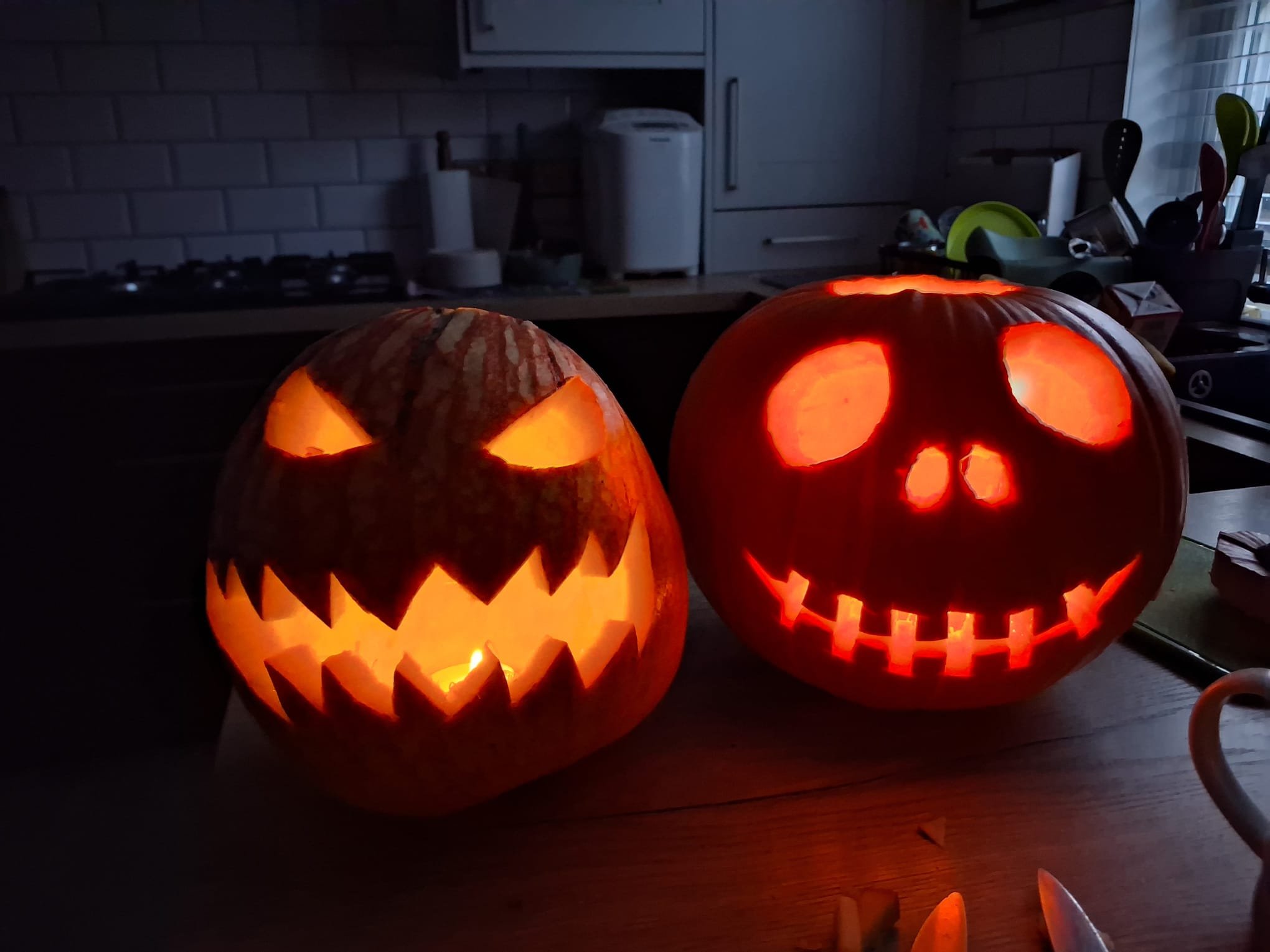
Two pumpkins, excellently carved by my sister Nina only yesterday (accompanied on WhatsApp by ‘…still got all my fingers!’)
So, when did Samhain become Hallowe’en? In the 800s, the Catholic church brought in a new feast day to celebrate saints called, somewhat unimaginatively, All Saints’ Day. The Catholics already had form for nicking pagan festival dates and traditions and rebranding them (see Christmas and Easter), so they took the old English words for ‘All Saints’ – ‘All Hallows’ – and renamed Samhain as All Hallows’ Even (AKA ‘Eve’). It wasn’t long before that was shortened to Hallowe’en (that’s what that apostrophe is there for – to show that a letter is missing).
Beggars, bitey apples and a bladdered Irishman
So what about some of the traditions that go along with modern-day Hallowe’en?
Trick-or-treating (or ‘trickle treeting’ as I saw it referred to on social media a few years ago)
In medieval Europe, poor children would go door to door begging for food and money during the feast day, offering to pray for the souls of their neighbours’ recently departed relatives. This later morphed into the more familiar kids-mugging-you-for-sweets that we get today.
Bobbing for apples
Because the veil between the physical world and the spirit world was thin during Samhain, it was seen as a great time to have a go at predicting the future. One of these fortune-telling games involved bunging a load of apples in a tub of water, with each one representing a local eligible bachelor or bachelorette. Young people would try to bite an apple without using their hands. And if you grabbed one on the first try, it meant you were destined to marry the person represented by it.
Carving pumpkins
This goes all the way back to the 1660s and an Irishman named Stingy Jack. To cut a long legend short, Jack was a pisshead who had a run-in with the Devil (we’ve all been there of a Friday night) and ended up doomed to walk the earth for all eternity with only a candle in a carved turnip to light his way.
People began to make their own versions of Jack’s lanterns from various root vegetables, and put them in their windows or doorways to frighten him or any other wandering evil spirits away. Scottish and Irish immigrants to the US brought jack-o’-lanterns with them, switching to the more-available native pumpkins.
While we’re talking about pumpkins, that word comes from pepon, which is Greek for ‘large melon’ (stop it). The French changed this to pompon, which in English became ‘pumpion’, before American colonists changed it to ‘pumpkin’. The term doesn’t have an agreed botanical or scientific meaning, however, so it can refer to basically any kind of winter squash-type vegetable. Although a pumpkin is actually a fruit, specifically, a type of berry. A bloody big berry, but a berry nonetheless.
Pumpkin facts!
The oldest pumpkin seeds were found in Mexico and are believed to date from between 7000 and 5500 BCE. That is a bloody long time ago.
The record for the heaviest pumpkin is 1,431.5 kg (3,156 lb) and was grown by an American man called Ron Wallace on 10 October this year (2026, in case you’re reading this in the future). This surpassed the previous record of 1,295.8 kg (2,856 lb 12.8 oz) which was set only a WEEK earlier by one Ian Paton from the UK. Hopefully Ian wasn’t too upset about only holding the record for seven days as he and his twin brother, Stuart, had previously had it for a year after a 2025 pumpkin tipped the scales at 1,278.8 kg (2,819 lb 4 oz). (Not sure what happened to Stuart for the 2026 pumpkin.)
Pumpkin chucking (also called punkin chunkin and pumpkin chunking), is the ‘sport’ of throwing pumpkins as far as possible using mechanical things including slingshots, catapults, trebuchets and pneumatic cannons. The record is 1,690.25 m (5,545.43 ft). Unfortunately an event in 2017 ended in a lawsuit (someone got hit in the head), which meant punkin chunkin went a little quiet for insurance-related reasons. Two years later, the championship relocated to Illinois for better legal protection, but turnout plummeted – mostly because asking people to haul multi-tonne, custom-built air cannons 800 miles across the US is a tall order. Attempts to move the event back toward the East Coast then ran into another legal wall: Maryland’s strict firearm laws classified the high-powered pneumatic pumpkin cannons as illegal destructive weapons. Combine that with COVID-related restrictions, and the event ground to a halt – apart from a brief, one-off tournament in Oklahoma in 2023 – leaving the future of extreme, weaponised pumpkin launching in limbo. Shame.