
This seems quite fitting with the announcement of the new James Bond a day or so ago (although I’m still not sure how I feel about Robert Pattinson – I was Team Edward back in the day though, so I should probably give him the benefit of the Bondy doubt). A sniper is a sharpshooter, often a cold, calculated killer taking out villains from a city rooftop using high-powered optics. But, why are they called ‘snipers’? In fact, the term’s origins are surprisingly peaceful.
Come with me to the muddy marshlands of 18th-century British India.
Live and Let Fly
A snipe is a long-billed shorebird belonging to the family Scolopacidae (which also includes sandpipers and woodcocks). The name has been around since the 14th century, and likely comes from an Old Norse word, -snípa, from a verb meaning ‘to nip’ or ‘to snap’.
Snipes are known for two things. First of all, their mottled brown, buff and black plumage means they’re experts at camouflaging themselves in reeds and marsh grass. Second, when they’re startled from cover, they erupt into the air, shouting, then fly away in a violent, unpredictable zigzag pattern (much like me when my alarm goes off every morning).
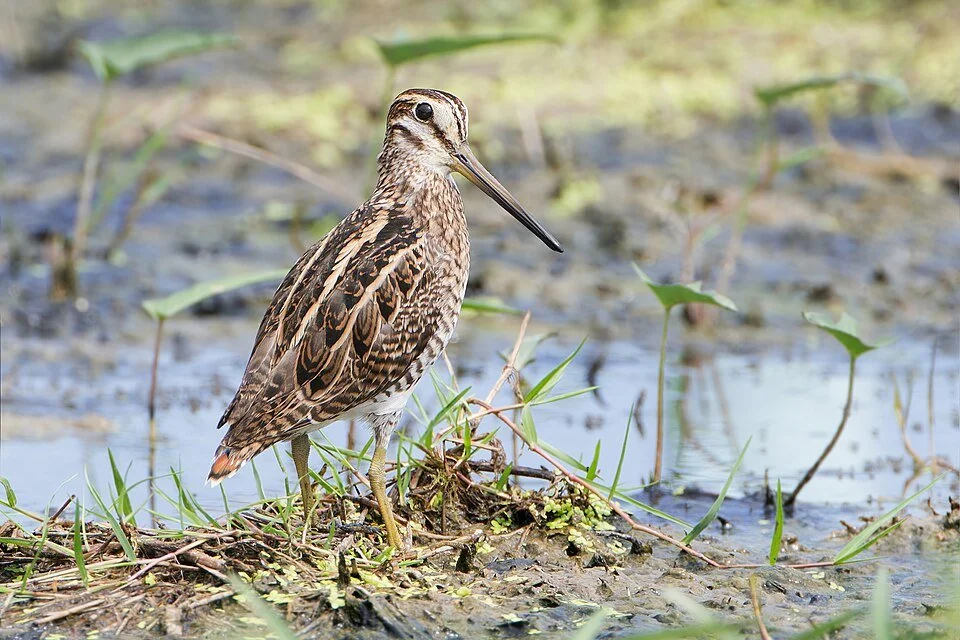
These things make snipe incredibly difficult for hunters to (a) find and (b) shoot. For that reason, in the days of single-shot, slow-firing shotguns, hitting a snipe on the wing was considered the ultimate test of a shooter’s skill.
For Your Sideways Eyes Only
So why are snipes so good at pissing off hunters? Well, their eyes are much higher and further back on the sides of their heads than some other birds. Like Linda Blair in The Exorcist, this gives them a full 360-degree field of vision, which apparently means they can still watch for predators above and behind even when their faces are buried in the mud sniffing out all those delicious worms and insects.
Aside from annoying stupid men with guns, snipe also have some other unusual biological traits. Their impressively long bills are packed with sensory pits (called the corpuscles of Herbst, fact fans, which sounds like a novel by Frank Herbert) which help them detect the faint vibrations of their underground prey. They can also open just the tip of their upper mandibles while keeping the rest of their beak closed, which means they can grab and swallow worms without having to remove their bill from the soil.
During snipe sexy time, the males fly high into the air and then dive steeply. As air rushes over their outer tail feathers, they vibrate, producing a haunting sound known as ‘drumming’ or ‘winnowing’, something that was once attributed in folklore to ghosts or spirits. Somewhat less romantically, people also thought the noise sounded like goats bleating, which is why they’re literally named ‘sky-goat’ in some languages including German (Himmelsziege) and Finnish (taivaanvuohi). And in French they’re called chèvre céleste or ‘heavenly goat’.
Oh, and the collective noun for snipe in English is ‘wisp’, which is lovely.
From India with Love
During the late 18th century, shooting snipe was a popular, if irritating (although I can’t say I feel particularly sorry for them), way to pass the time for British officers stationed in colonial India. Because the birds were so difficult to bag, anyone who could consistently bring them down would get amazing bragging rights among their bloodthirsty peers. And these soldiers, as well as administrators in India, began using the verb ‘to snipe’ to describe hunting these birds. By the early 1820s, the noun ‘sniper’ entered the Anglo-Indian lexicon to describe a particularly skilled hunter who was capable of accurately hitting that poor old bird.
Not long after this, the term crossed over from sport to combat. Because humans have always been great at finding new ways to kill each other, in the 19th century, military units started using rifled barrels which dramatically increased the range and accuracy of their guns. With specialists now able to pick off enemy officers and sentries from hidden positions at long distances, soldiers naturally borrowed the sporting term ‘to snipe’ to describe shooting an enemy from cover.
Fast forward to World War I, and the term ‘sniper’ had become a vital but feared role in modern armies.
The People With the Golden Guns
A few snipers have made the history books for being amazing at shooting things from far away, and I’m pleased to report that one of them is an actual woman.
Simo Häyhä, AKA ‘The White Death’
Generally regarded as the deadliest sniper in history, Finnish farmer Simo Häyhä is believed to have killed more than 500 enemy soldiers during the Winter War between Finland and the Soviet Union, the highest number of sniper kills in any major war. His nickname came from the all-white camouflage he wore.
On 6 March 1940, a week before the end of the war, Häyhä was shot in the face by a Red Army soldier. Presumed dead, he was placed on a pile of corpses. Thankfully someone later noticed his foot moving, and he was taken to hospital where he recovered (even writing to a newspaper to correct an article that had reported his death), although he was badly scarred. He died on 1 April 2002, aged 96. Oh, and three different heavy metal bands have written songs about him.
Francis Pegahmagabow, who didn’t get a cool nickname, sadly
An Anishinaabe (Ojibwe) soldier from the Wasauksing First Nation in Ontario, Canada, Pegahmagabow was the most effective sniper of World War I, and also the most highly decorated Indigenous soldier in Canadian military history. He’s credited with 378 kills.
Pegahmagabow died in 1952 having fathered six kids but only one heavy metal song, unfortunately. He did inspire a musical (which is weird), however – Sounding Thunder, The Song of Francis Pegahmagabow has been touring Canada since 2018.
Lyudmila Pavlichenko AKA ‘Lady Death’
Serving in the Red Army during World War II, Pavlichenko is credited with 309 confirmed kills during the sieges of Odessa and Sevastopol, making her the most successful female sniper in recorded history (and yes, there are others – I checked). After being injured by a mortar shell, she trained other snipers and was a public spokeswoman for the Red Army. She also toured the United States, Canada and the UK, and was the first Soviet citizen received by a US president at the White House.
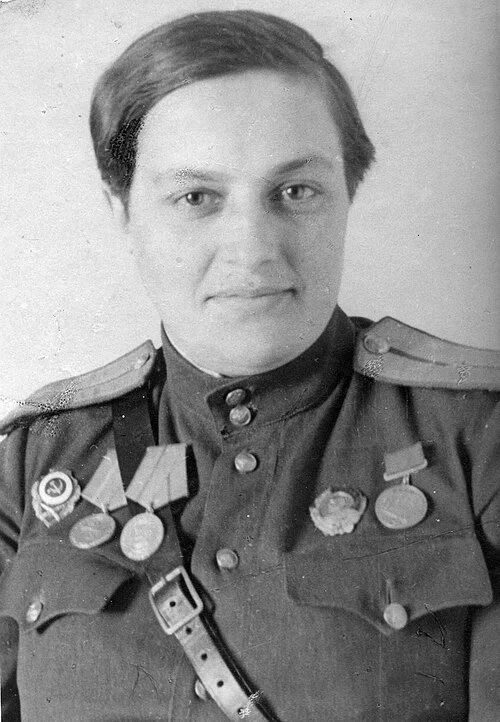
Lyudmila Pavlichenko: don’t ask her about her knickers (photo: Pravda (1944) / public domain)
Despite being an expert with a deadly weapon, Pavlichenko was STILL subjected to endless sexist comments and questions by the media who didn’t take her seriously, referring to her as the ‘Girl Sniper’. Apparently reporters even criticised the length of the skirt of her Red Army uniform, saying that it made her look fat. They also asked if she used makeup on the front line. Risky questions for a woman who could blow your head off with pinpoint accuracy.
Thankfully, Lyudmila gave as good as she got, challenging an especially sexist reporter to a fistfight. She also responded to a question about her underwear with this:
‘I am proud to wear the uniform of the legendary Red Army. It has been sanctified by the blood of my comrades who've fallen in combat with the fascists.’
RESPECT.
(Any excuse for a little bit of my favourite all-too-brief-Bond, Timothy Dalton)