

If, like me, you’re a dog person, you probably associate the word ‘pedigree’ with overly pampered pooches – or the word ‘chum’. Of course, we also use it to describe anything with a snooty background, like royals or break-the-bank wine. But if we peel back the layers of history, the origins of the word ‘pedigree’ are actually quite unglamorous. And French.
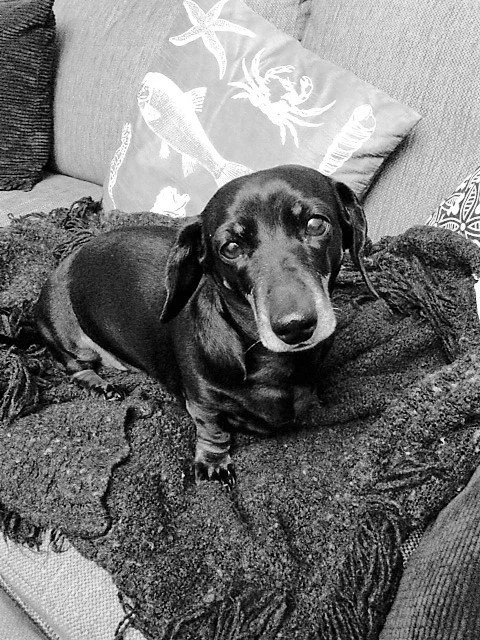
Lovely Bella, sadly no longer with us
Our story begins in Anglo-Norman French, somewhere around the early 15th century. Without Ancestry.com or online DNA tests, medieval genealogists drew up family trees to prove who’d fathered who and who owned which chateau. They would draw a three-pronged symbol – three lines radiating from a single point – that connected parents to their offspring. That three-lined diagram looked very similar to the footprint of a large bird, specifically, a crane. So the term ‘pié de gru’ was born, which literally translates as ‘foot of a crane’. (Now, if you remember your GCSE French, or you’re familiar with the scary French Duolingo chouette, you might be thinking ‘sacre bleu, the French word for “foot” is “pied” not “pié”, you plank’. And you would be right – but, back in the medieval period, spelling was a bit of a free-for-all, and it was routinely written that way. Later, poncy scholars who wanted to make the word look closer to its original Latin root stuck a ‘d’ on it.)
Anyway, I digress. As you can probably guess, over the centuries, English speakers did what we do best: we stole the French phrase, chewed it up and spat it out as ‘pedigree’. By the late 16th century, the new spelling had stuck, and the word shifted from describing the physical diagram on a parchment to meaning the ancestral line itself. By the 18th century, the term expanded beyond human aristocrats to include the selective breeding of horses and cattle, eventually landing us where we are today – with certificates for purebred poodles.
My previous dog, Bella, was a purebred dachshund who did indeed come with a certificate. (I’d like to emphasise that I didn’t buy her – I took her on after her previous owner, my great aunt, passed away.) I adored Bella but, as well as that certificate, she came with all sorts of health problems – including terrible back issues due to years of selective breeding to produce that distinctive sausage shape. It’s a sad fact that the pursuit of the ‘perfect’ pedigree has left a tragic legacy across the canine world – as well as dachsies with dicky backs, we also have pugs who can’t breathe properly, German Shepherds with broken hip joints, Shar-Peis with severe skin infections, Great Danes with failing hearts and deaf Dalmatians (I could go on…). Breeding for a specific look often comes at a massive cost to dogs’ quality of life – so if you’re looking to get a dog, remember that rescue is the best breed.