
A furlong is one of the many, MANY units of distance we use in English that I don’t understand (see also, yard, acre, fathom, nautical mile… I could go on). One thing I do know about furlongs is that they’re mainly used in horse racing. And the internet has just told me that a furlong is equal to 220 yards, which means NOTHING to me, but is apparently an eighth of a mile – about 201 meters – both of which I do, just about, understand.
Thankfully this post is about words, not how bad I am at understanding how far away one thing is from another thing. We can trace ‘furlong’ back to an Old English word, ‘furlang’, which combines two words:
the noun (person, place or thing) ‘furh’ meaning ‘furrow’, as in a trench made by a plough to put seeds in (and also my brow when thinking about units of distance)
the adjective (describing word) ‘lang’, which just means ‘long’.
These two words give us a big clue to what the word furlong was originally used for – and it wasn’t always defined as precisely as it is now. It previously referred to the length of a furrow in a cultivated field. This length was equal to the long side of an acre (that’s me lost again), an area originally defined as the distance a yoke of oxen (there are two oxen in a yoke, apparently) could plough in a straight line before needing a sit down and a cup of tea. Which surely changes depending on how beefy (pardon the pun) your oxen are, right? Presumably that’s why this was later standardised as an area measuring 220 yards by 22 yards, and is now defined as any area measuring 4,840 square yards.
Off to the races
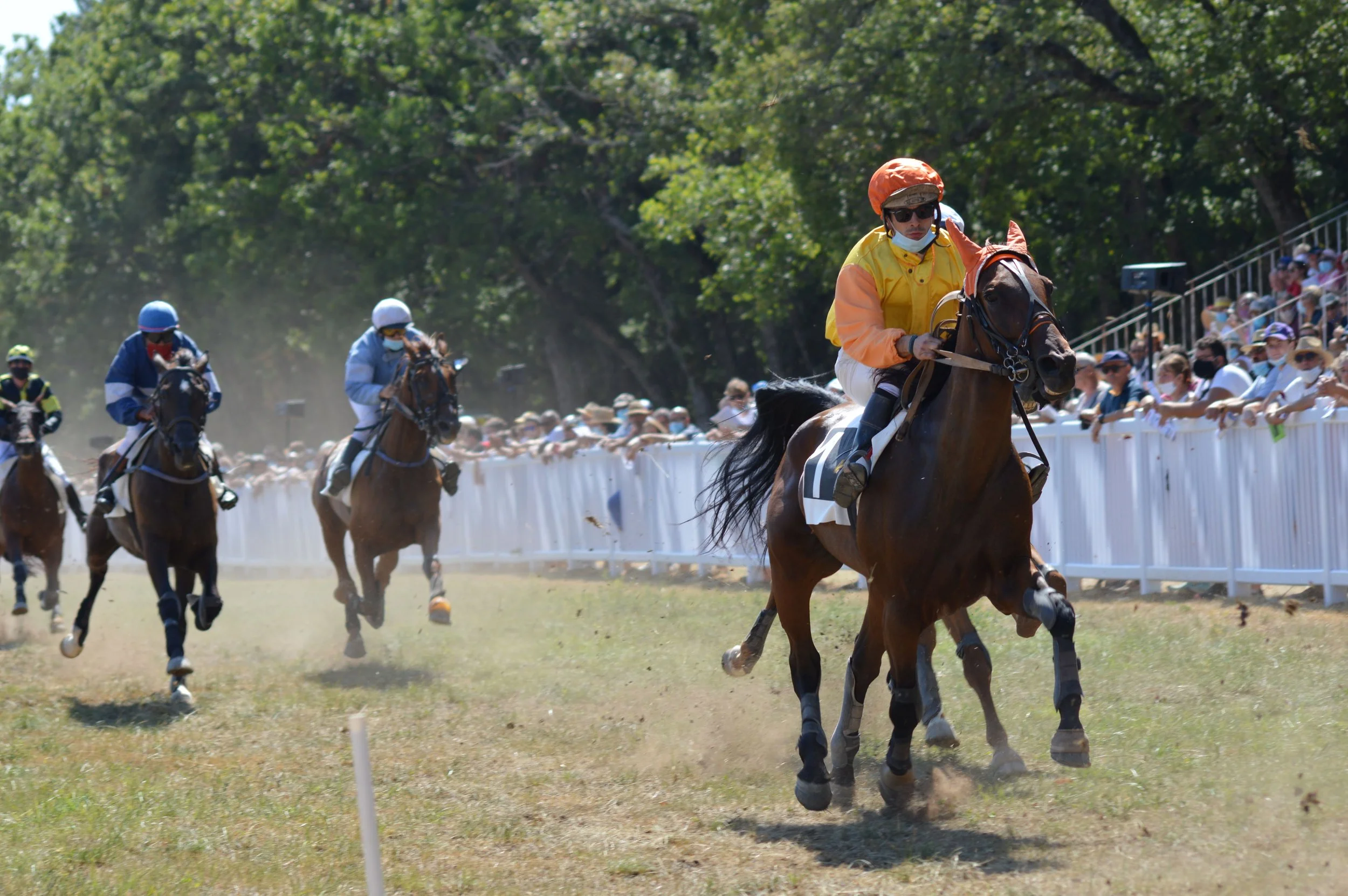
So how did furlongs go from furrows to thoroughbreds? Well, that happened during the 16th and 17th centuries, around the time organised horse racing first emerged in England under the reigns (not reins) of King James I and King Charles II. Of course, people have been racing horses as long as they could sit on them, but largely informally in rural settings. The 1500s and 1600s saw the beginning of organised competitions on open tracks (like Newmarket), and racing authorities needed a reliable way to measure the length of courses. Because the furlong was already established for measuring open land and fields, it made sense to adopt it for tracks too.
Other units that refuse to die
The English language is full of archaic units that have survived within specific industries, sports or legal contexts. Here are just a few of those:
chain (22 yards/66 feet/roughly 20.1 meters): used for measuring cricket pitches (the distance between the two wickets on a cricket pitch is exactly 1 chain) and railways (Network Rail still measures the entire British railway infrastructure in miles and chains)
rods, perches and poles (5.5 yards/16.5 feet/5.03 meters): three names for the same measurement, which is used for allotments – a standard UK allotment plot is 10 rods/poles/perches, or about 250 square meters, apparently. It has three names because there were three different types of stick previously used to measure land
cable (100 fathoms/a tenth of a nautical mile/around 185 meters): used by the Royal Navy and British mariners as a short-range distance measure (e.g., ‘there’s a ship passing 3 cables off the starboard bow, Jim’)
thou (0.001 inches/0.0254 mm): British automotive mechanics, historic engine restorers and manufacturing machinists use thous for spark plug gaps, feeler gauges and metal foil thicknesses.
Parsecs and plot holes
It seems I’m in good company when it comes to not really understanding measures of distance. In Star Wars: A New Hope, Han Solo says that the Millennium Falcon did the Kessel Run ‘… in less than twelve parsecs’. But a parsec is a measure of distance, not time (about 19 trillion miles or 3.26 light years).
No one’s quite sure whether this is a mistake by George Lucas or a deliberate choice to show that Solo was just a big old (hot) bullshitter trying to impress local yokels Obi-Wan and Luke in the Mos Eisley Cantina because he needs their credits. There’s also a theory (which started in the Expanded Universe and was officially made canon in the frankly rubbish 2018 movie Solo: A Star Wars Story) that the Kessel Run was normally an 18-parsec route which went around the Maw, a cluster of black holes. Han’s claim to have made it in less than 12 parsecs is actually a boast about both his ship’s speed and his skills and daring as a pilot because he shaved a third of the distance (and precious time) off the normal route by flying dangerously close to the black holes.