

The English language has a lot of words for ‘talking a load of crap’ – balderdash, claptrap, waffle, baloney, guff, bull, poppycock… I could go on. ‘Bunkum’ is yet another one of these monikers for spouting a bunch of rubbish. But unlike its counterparts, it has a uniquely well-documented origin. Come with me to early 19th-century America, and specifically to the United States House of Representatives.
On 25 February 1820, lots of old white men (some things don’t change) were tensely debating whether to allow Missouri to become a state. Now, my American history is patchy at best, but I understand from the internet that this was controversial because Missouri was a slave-owning state. And letting it join could set a precedent for allowing slavery across the entire western frontier.
The debate had been raging in the House continuously for nearly a month. Various congressmen had delivered lengthy, dramatic speeches each day, and every conceivable argument for and against slavery had been repeated. It was all going in circles and everyone was desperate to stop talking and start voting.
Enter Felix Walker, representative for Buncombe County in North Carolina. In a moment of apparent madness, he decided that this was the perfect time to start a long, rambling speech. When his exasperated colleagues tried to cut him short by interrupting, shouting and generally trying to drown him out to force the vote, he insisted he wasn’t trying to persuade Congress, but ‘speaking for Buncombe!’. Walker’s colleagues immediately saw through this blatant publicity stunt to impress voters back in North Carolina, and he was shouted down after only a sentence or two.
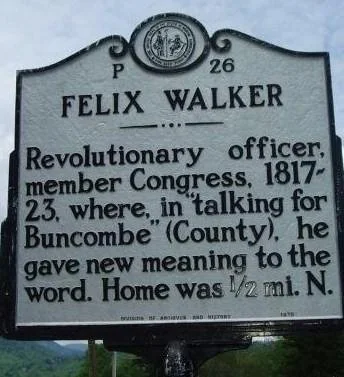
(Photo: ML ’Mitch' Gambrell / HMdb.org)
Not long after this, the phrase ‘speaking for Buncombe’ caught on in Washington as a way to describe a politician giving an empty, bombastic speech meant solely for pats-on-the-back and electioneering rather than to make any actual political points (sound familiar…?). In the 1830s and 1840s, the spelling shifted phonetically to ‘bunkum’, and the term moved from meaning ‘political bollocks’ to ‘general bollocks’. A writer called Thomas Chandler Haliburton then popularised the term internationally in his Sam Slick collection (which I’ve never heard of, but which was apparently Canada’s first international best-selling novel). Then in the late 19th century, ‘bunkum’ was shortened to ‘bunk’, which is where we get the verb ‘debunk’ from.
Now, don’t feel sorry for Walker. As well as being a supporter of slavery, according to historical accounts, he knew he was going to be cut off – he simply wanted to make sure he was seen trying to speak for the people. Later, he handed his massive 4,879-word (yup) speech straight to local newspapers who published the whole thing as if he’d delivered it in full. So he was able to send copies home and impress his voters without actually having read any of the words on the floor.
Despite this, there’s something quite satisfying about the fact that Felix Walker – slave-owner, defender of human bondage and white supremacist – is now remembered as a funny historical footnote who gave us the word ‘bunkum’. Fingers crossed, many of the modern-day racist politicians we continue to allow into the limelight will be remembered for similarly stupid moments.
(Oh, and in case you’re wondering, the House of Representatives eventually struck a deal called the Missouri Compromise: Missouri joined as a slave state while Maine joined as a free state to keep the power equal. A geographical boundary line was then drawn to decide where slavery could and couldn’t exist in the future.)