
I heard this term on that bastion of intellectual rigour, Coronation Street, when Tracy Barlow used it to describe booting Mary (my favourite character) out of her florist’s job. And that got me thinking – what even is a cakewalk?
If you aren’t a fan of Corrie, or you haven’t come across that term before, we use it to describe something that’s effortless or very easy. This slang meaning dates back to at least 1895 in American English. But it turns out that in the 19th century, a cakewalk was anything but an easy ride.
High kicks and hidden jokes
Our story starts in the American South during the mid-1800s, at gatherings held by enslaved African Americans on plantations. These events often included a dance contest called a ‘prize walk’ where the winners would walk away with a cake. The friendly competitions produced a particular routine which was originally called the ‘chalkline-walk’ or the ‘walk-around’. But thanks to that yummy prize, it eventually became known as the cakewalk.
Inspired by a formal European couples dance called the Grand March and jazzed up (literally) with energetic moves from African dance traditions, the cakewalk involved couples parading down a line with their chests puffed out, leaning slightly backward, throwing in high kicks, twists, shuffles and slides. It was also influenced by something called the ‘ring shout’, a religious ceremony where participants would shuffle their feet anticlockwise in a circle formation while singing lines back and forth with a crowd outside the ring.
Slaveowners often encouraged these contests, happily handing over cakes for prizes and seeing the whole thing as a nice way to show off their ‘benevolence’. But what they didn’t know was that, according to accounts passed down through the years, the dancers were actually poking fun at them. The cakewalk was a piss-take in plain sight of the stiff, overly formal ballroom dances – like minuets and waltzes – loved by the white slaveholders. According to Wikipedia, one man recalled his nanny saying of the dance: ‘Sometimes the white folks noticed it, but they seemed to like it; I guess they thought we couldn’t dance any better.’
There were other versions of the cakewalk too. An entertainer called Tom Fletcher, born in 1873, wrote in 1954 that his grandparents told him about the chalk-line walk/cakewalk as a child. In their version:
‘… there was no prancing, just a straight walk on a path made by turns and so forth, along which the dancers made their way with a pail of water on their heads. The couple that was the most erect and spilled the least water or no water at all was the winner.’
A greatly simplified version of the cakewalk also spread beyond dance to carnivals, school fetes and church fundraisers. This was a game of pure chance though – organisers painted numbers on the floor in a circle and people then strolled around while music played. Whoever happened to be standing on a randomly drawn number when the music stopped won a cake.
From bopping to Broadway
In 1876, the cakewalk dance went mainstream, when it was part of a major exhibition in Philadelphia. It was then picked up by minstrel shows, where it was only danced by men. The less said about this, the better, but I’m sure the irony of white performers in blackface mocking a dance that was invented as a mickey-take out of white high society isn’t lost on you.
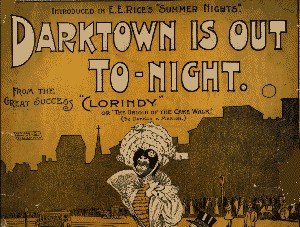
By Edward E Rice - http://jass.com/, public domain, https://commons.wikimedia.org/w/index.php?curid=148458520
As per fricking usual, it would take another 20 years or so for women to join the party (although actually that’s quite quick for the patriarchy). In 1893, a married duo called Dora Dean and Charles E Johnson became huge stars after performing their cakewalk on The Creole Show, a theatrical production that ran from 1889 to 1897. As it so often does, getting women involved made everything better and inspired new, more creative versions of the dance, turning it into a nationwide craze. Then, in 1898, a Broadway musical comedy called Clorindy, or The Origin of the Cake Walk made history as the first Broadway musical with an all-Black cast.
It wasn’t long before the rest of the world decided they wanted to get in on the cakewalk fun. In 1900, French music hall star Eugénie Fougère brought the dance to Paris after she returned from a tour in the US. And for a few months in 1903 the French capital was completely swept up in a folie du cake-walk – cakewalk fever. That same year, the dance turned up in Buenos Aires, Argentina, where it might even have influenced early versions of the tango.
Of course, a dance this good needed a banging soundtrack. Most cakewalk music is notated in a 2/4 time signature with two beats per bar and plenty of syncopation. If, like me, you have no idea what that means, I think it translates to ‘oompah’. These catchy tunes caught the ear of composers on both sides of the Atlantic, including Claude Debussy, who was inspired to write two pieces for the piano, the names of which I won’t repeat here – to say they haven’t aged well is a massive understatement.
As well as composers, the cakewalk also inspired a fairground ride (although ‘ride’ seems like a bit of stretch, to be honest). Punters walked across moving bridges that rocked up and down and back and forth. I think it might be like that one at the end of Grease, for those of you who remember that. They often included a fairground organ too, so whenever the operator cranked up the music, the walkway sped up too, producing many a You’ve-Been-Framed moment, I’m sure (another dated reference there, sorry).
The icing on the etymology
So far, so not-at-all-effortless. But how come ‘cakewalk’ was used as early as 1895 to indicate something easy peasy lemon squeezy? There are a couple of theories about this. One is that the best cakewalk dancers made that tough, athletic routine look super easy. Another is that it’s simply a reference to that carnival game I mentioned above, where all you had to do to win the coveted baked goods was turn up and wander about. Whatever the answer, ‘cakewalk’ also gave us the phrase ‘takes the cake’ (although not ‘piece of cake’ which was 1930s Royal Air Force slang).
Not a bad bit of history for a throwaway line on the cobbles – thanks, Tracy.