

Mythological creatures

aegis

‘Aegis’ is a fancy-dancy word that refers to the power to protect, control, or support something or someone. It often pops up in the phrase ‘under the aegis of’ (although not in anything I’ve written, I’m pleased to say). For example:

‘The ultimate owner of the best spot on the sofa will be decided under the aegis of the dog.’
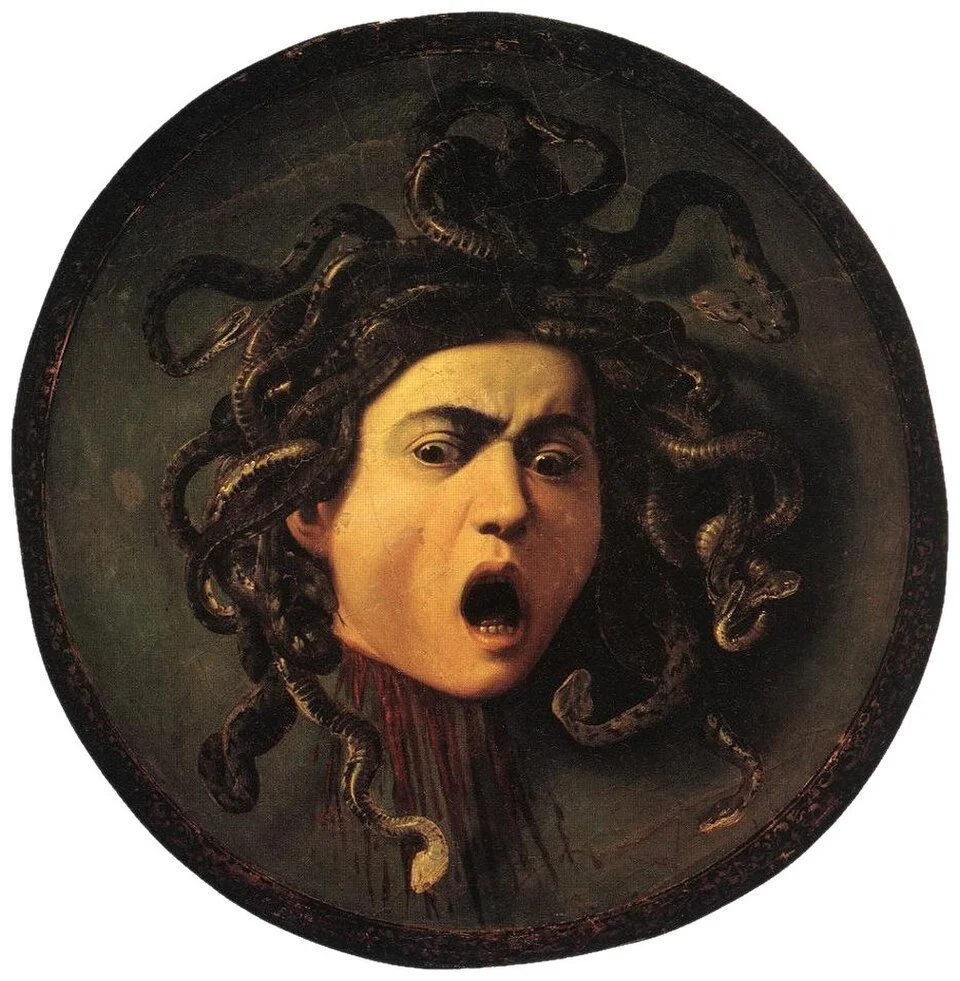
Medusa, coming at ya

You’ve probably guessed from the spelling that we nicked ‘aegis’ from Latin. But the word it actually comes from is Greek – aíx. Bet you can’t guess what that means.

I’ll give you a sec.

The answer is, not at all obviously, ‘goat’.

So how did we get from hairy, eat-anything Goaty McGoatface to protection and control? Well, in ancient Greek mythology, the god Zeus (and later his daughter Athena) carried a powerful shield or cloak called aegis, which was made from the skin of Amalthea – a mythical goat that suckled Zeus as a baby. Yep. I mean this is the guy who turned himself into a golden shower (shut up), poured through a skylight and impregnated Harry Hamlin’s, sorry, Perseus’ mum, so being suckled by a goat is frankly one of the less weird things about him. (I should probably say that in early accounts, Amalthea was a nymph who owned a goat whose milk Zeus drank – much less weird, but also less interesting.)

Anyway, back to the shield. This was not just any old goatskin shield – the snake-covered head of the Gorgon Medusa (killed by the aforementioned golden-shower-fathered Perseus) was mounted on it. And because you can never have too many reptiles on your shield, it was also fringed with extra snakes who’d snap at anyone getting too close. The OG biological warfare. (Much like the nymph/goat merging above, Homer described the shield’s fringing as golden tassels, but later artworks depicted them as snakes – and that’s clearly much more exciting.)

Over the centuries, the word ‘aegis’ made its way through Latin and into English where 19th-century printers insisted on snobbishly gluing the first two letters together as ‘ægis’ (called a ligature, fact fans). Along the way it shed both the stuck-together letters, the goat hide and the snakes (dammit!), eventually settling down as an unnecessarily formal synonym for sponsorship, backing or protection.

So, next time you hear someone say they’re acting under the ‘aegis’ of an official authority (or a cavapoo called Gus, if you’re me), remember: they’re really just hiding behind a big-old goat skin.

Alongside ‘Terrahawks’ (look it up if you’re too young to remember it), this scene was one of the scariest things I saw as a child in the 80s.

chimera

A chimera (pronounced ky-MEER-uh or kih-MEER-uh, depending on who you ask) is something made up of different parts. The original Chimera (with a big C) was a fire-breathing creature n Greek mythology with the head of a lion, the head of a goat on its back and a serpent for a tail. The name comes from ‘khimaira’ (Χίμαιρα) which means ‘she-goat’.

There’s also a mountain in southern Turkey named after the chimera. Mount Chimaera (or Yanartaş) is a rocky hillside where natural gas seeps from cracks in the earth, creating flickering fires that burn night and day. With lions, goats and snakes roaming the surrounding hills, it’s easy to see how it came to be named after a hybrid beast that spat flames.

Chimeras aren’t just mythological. Don’t worry though, you’re not going to run into a fire-breathing goat mix on your next package holiday. We’re talking science here – specifically, genetics. A chimera is an organism made up of cells from two different sources, something that can happen naturally or in a lab. Humans and animals can be chimeras when two fertilised eggs fuse into a single embryo, which means they end up with two sets of DNA. This can go completely unnoticed or reveal itself in surprising ways, like different coloured eyes or patches of skin with different pigmentation.

One famous example of a human chimera is an American woman called Karen Keegan. In 2002, she needed a kidney transplant and used genetic testing to find a donor in her family. But the tests showed that genetically she couldn’t be the mother of her sons. The mystery was solved when doctors discovered that Keegan was a chimera – the DNA in her blood cells was different to that in the other tissues in her body. That’s because when her mother was pregnant with her, two separate eggs had been fertilised, creating two separate balls of cells each with its own DNA. At some point, these two groups of cells fused into one, and Karen was born with cells from both balls randomly distributed throughout her body. I’m pleased they figured that out – it could have led to some super awkward questions otherwise.

Chimeras are also a godsend for crime writers – I’ve definitely seen them used in more than one drama when DNA evidence at a crime scene was discredited because the suspected perp was actually a chimera.

This is Venus the Two-Faced Cat, an American tortoiseshell cat whose face is half black and half red tabby. Opinions differ as to whether she’s a true chimera or her markings are simply a matter of luck and heterochromia (two different coloured eyes). Whatever the real answer, she looks awesome. (And you can of course follow her on Instagram.)