

I expect you know what ‘ethereal’ means – it’s an adjective we use to describe things that feel delicate, heavenly or otherworldly – misty mornings, choirs singing in ancient churches or dust motes drifting through the sunshine (aside from the fact that those are almost certainly dead skin).
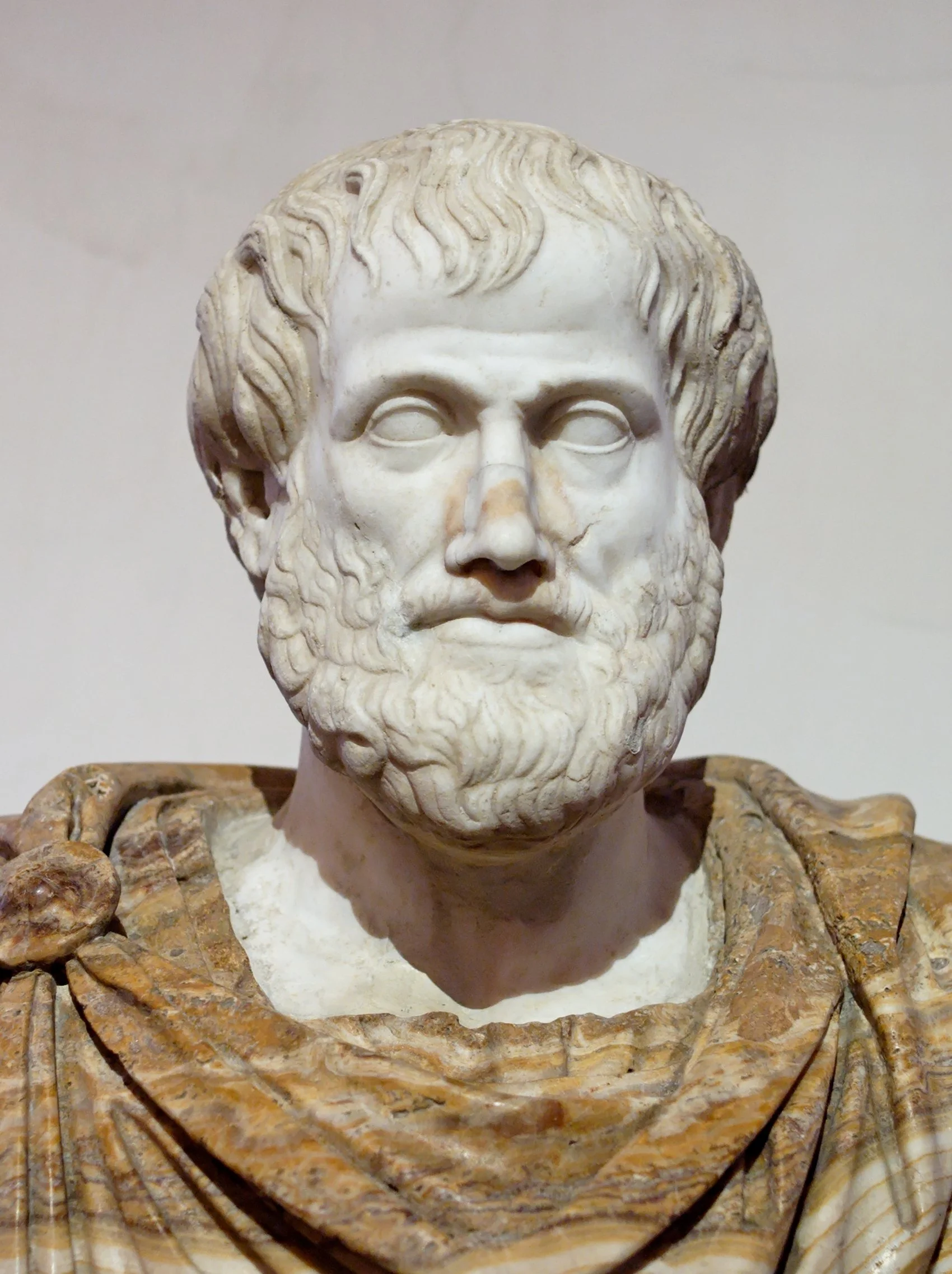
Why did Aristotle hate French fries? They were fried in ancient grease!
(Image: After Lysippos, public domain, via Wikimedia Commons)

‘Ethereal’ came to English via ‘ether’ which used to have ‘a’ on the front of it: ‘aether’. That word traces back to the ancient Greek aithēr (αἰθήρ), meaning ‘pure, fresh air’ or ‘clear sky’. In Greek mythology, aithēr was the pure, clean upper air breathed by the gods while us mere mortals were left breathing shitty old aēr (ἀήρ).
Early Roman writers brought aithēr into Latin – it shows up in 2nd-century BC Roman drama like Pacuvius and later in Cicero – as aether. From Latin and French it made its way into English, where people eventually dropped the ‘a’ in everyday spellings, while keeping ‘aether’ for more classical or scientific contexts. ‘Ethereal’ itself turned up in English in the early 1500s to describe the upper sky and heavens, picking up the ‘light, airy and delicate’ sense around the 1590s and ‘spirit-like or otherworldly’ by the 1640s – all of it coming straight out of that idea of pure god-ly air far removed from earthly crap.
While ‘ethereal’ headed down a poetic, romantically misty path, its root, ‘ether’ had another life waiting in philosophy and science.
Aristotle takes five
Around 350 BC, Aristotle grabbed the theoretical concept of aether and ran with it, giving it a proper job in natural philosophy (AKA the study of nature and the physical universe).
Right, bear with me here as my A-level in philosophy was many, MANY years ago (and apologies to Aristotle for oversimplifying/completely bastardising your ideas). So, Arry (as no one called him) decided that everything on earth was made up of four elements – earth, water, air and fire – and that anything made of this things naturally moves in straight lines up or down unless something got in its way. Since stars and planets and other stuff up in the sky go in circles instead of falling down or shooting straight up, he thought they couldn’t be made of those four elements. So he came up with a fifth one which he called, you’ve guessed it, aether (also often called the quintessence in medieval Latin, which means ‘fifth essence’).
Such was Arry’s influence that this idea of ether as a fifth element hung around for centuries. But in the 17th, 18th and 19th centuries, aether got a scientific makeover. Instead of just being sky-stuff above our heads, it was drafted in to solve a problem with light.
This little light of mine
While apple-loving Isaac Newton and others thought light was made up of tiny particles, plenty of other thinkers argued that it travelled in waves. And that meant it needed something to travel through – like sound in air or ripples in water. Physicists recycled Arry’s old word ‘aether’ for that invisible medium and, presumably to make it more fancy-dancy, stuck ‘luminiferous’ (‘light-bearing’) in front of it to say what it did i.e. carry light.
Then came the Michelson–Morley experiment in 1887. This was based on the idea that if space was full of aether, Earth moving through it should create an ‘aether wind’ that pushed or slowed light depending on direction. American scientists Albert A Michelson and Edward W Morley used an optical device called an interferometer to try to measure Earth’s motion relative to this supposed stationary aether ‘wind’. This involved splitting a beam of light into two paths at right angles and bouncing them off mirrors to see if one arrived later than the other. (I asked Google Gemini to explain this to me with an analogy, and it said ‘Picture rowing a boat on a river: going upstream and back takes a different amount of time than going straight across the current.’ This makes zero sense to me as Earth goes in a circle, not a straight line, but I’ve included it in case it makes sense to you, dear reader. This is why I work with words, not physics.)
After all that, Michelson and Morley didn’t find any measurable difference, plunging luminiferous ether’s existence into doubt. This was further confirmed by some maths by Hendrik Lorentz (nope, me neither) and Albert Einstein (thankfully I do know who he is – the guy from the smart meter ads) which definitively proved that light doesn’t need a medium to travel through space. All of which meant luminiferous aether was unceremoniously dropped from physics.
Ether grows up
While physicists were busy consigning ‘luminiferous aether’ to the equivalent of the scientific recycling bin, ‘ether’ was quietly becoming a real boy, sorry, chemical compound. In the 16th century, alchemist Valerius Cordus mixed sulphuric acid and alcohol to produce an amazing cocktail (not really) called diethyl ether. Apparently he couldn’t be bothered to name it though (Cordus Cosmopolitan? Sulphur on the Beach?), so in 1730 August Siegmund Frobenius decided to call it ‘ether’. And by the 19th century, ether was being widely used as an early surgical anaesthetic.
All of which brings us full circle. Physics chucked out the aether, surgery moved on from the ether but somehow ‘ethereal’ came out the other side intact – and it’s still the go-to word when something feels too light, lovely or strange to belong in this shithole we call ‘home’.