

If you’ve ever woken up in the middle of the night and stared moodily into the darkness, you might have noticed that it isn’t actually black. Instead, it’s a faint, grainy grey. And believe it or not, that colour has a name – and no, it isn’t ‘grey’. It’s eigengrau.
Eigengrau is the shade your eyes perceive in complete darkness, when there’s no external light entering them at all. Rather than seeing pure black, our visual systems produce a sort of background ‘noise’, and the result is this soft grey-ey haze.
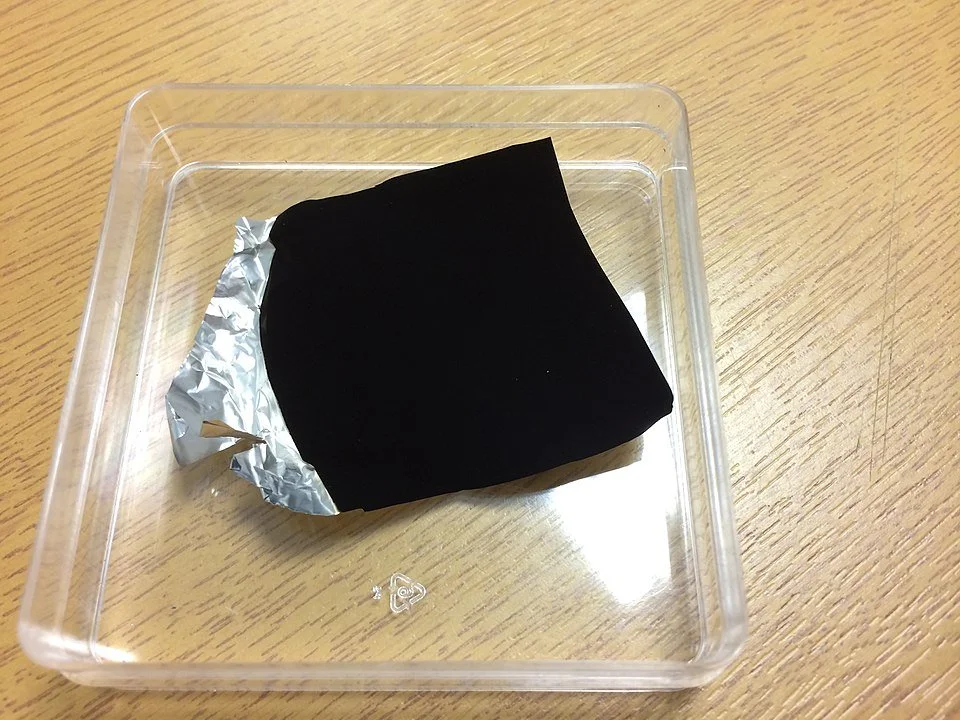
Vantablack is created by growing long microscopic carbon nanotubes in a field so dense that almost all light is trapped inside it.
You can probably guess that the word comes from German. ‘Eigen’ means ‘own’ or ‘intrinsic’, and ‘grau’ means, you’ve guessed it, ‘grey’. So it literally translates as ‘intrinsic grey’, which sounds like a colour they paint government buildings with or, more romantically, ‘one’s own grey’. The term is sometimes also called the ‘dark light’ of vision (and, more boringly, ‘visual noise’ or ‘background adaptation’). Scientists began studying this effect in the late nineteenth century while investigating how the retina behaves without stimulation from light.
So why does eigengrau look slightly lighter than true black? The effect comes from spontaneous activity in the photoreceptor cells in the retina – even when they’re not being hit by light, they still fire occasionally, and the brain interprets that activity as a faint visual signal. That’s also why you might notice little flickers or speckles when you close your eyes in the dark.
All this talk of colours reminds me of Vantablack, the blackest black of paints. It was developed by British company Surrey NanoSystems to use on stealth satellites, and reflects almost no light at all. Anish Kapoor, the British sculptor who designed the Orbit tower for the London Olympics, was given exclusive rights to use Vantablack artistically. That pissed off a load of artists who felt a colour (or colour-like material) shouldn’t be locked up by one person. One of the best responses came from another British artist called Stuart Semple. In 2016, he released a very bright pink pigment called Pinkest Pink, that he sold online with one condition: buyers had to confirm they were not Anish Kapoor and had no intention of letting him use it. The sales page even included a declaration along the lines of: ‘By adding this product to your cart you confirm that you’re not Anish Kapoor…’.
Semple used the same rule for many of his later materials too, including Black 2.0, Black 3.0, and various other pigments and paints, which were all sold to the public ‘except Anish Kapoor’. In June 2024, Semple officially changed his name to Anish Kapoor though, which presumably means he can’t use his own products.